

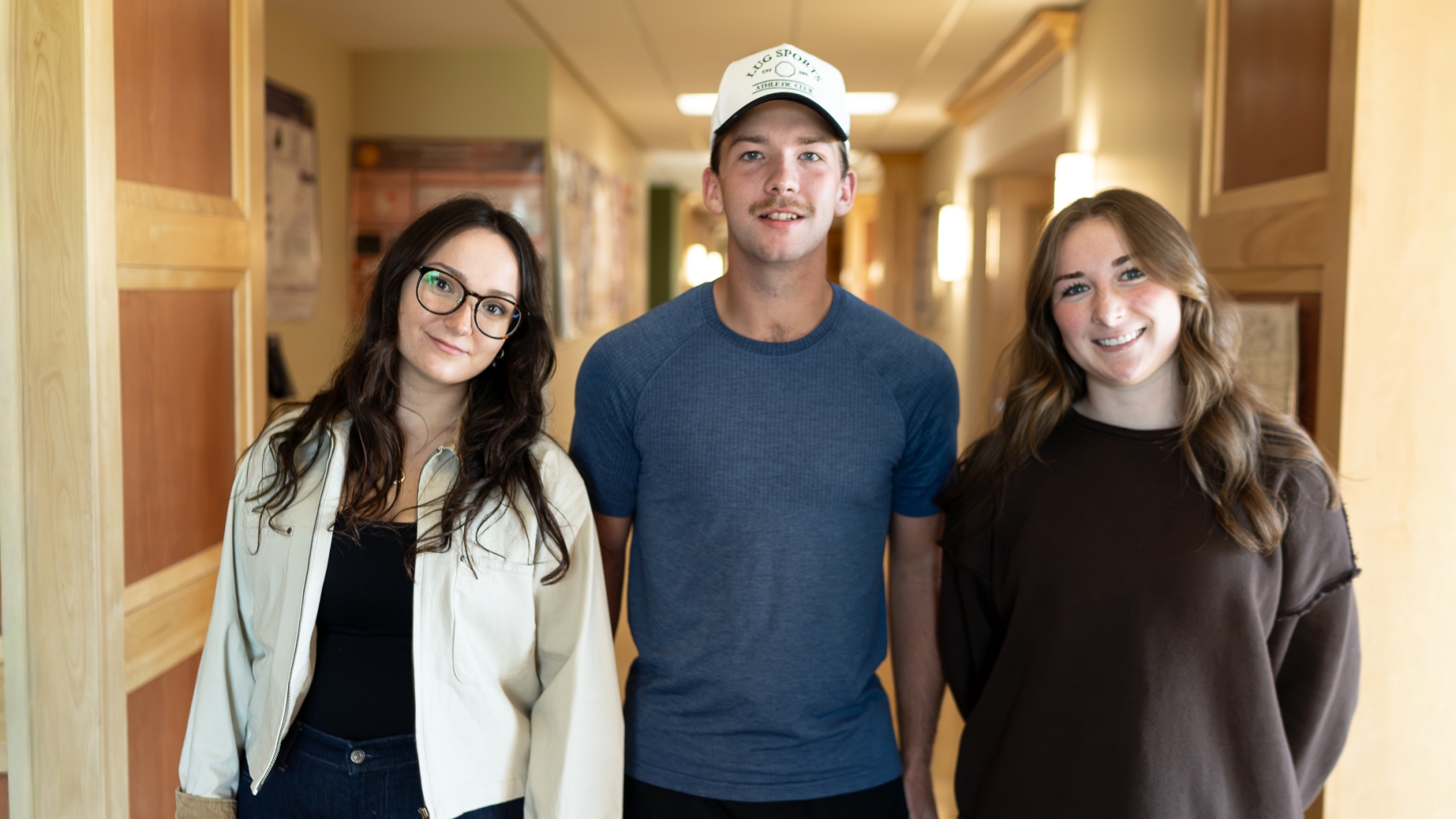
Being able to think like a researcher, develop confidence, and contribute solutions toward real-world problems were some of the benefits of receiving the Richard Cunningham Engineering Internship and the John P. Cunningham Internship (Chemistry), three StFX students say.
Named after brothers Richard and John P. Cunningham, the awards provide $9,000 for undergraduate summer research employment under the supervision of a StFX faculty member.
Scarlett Evans and Ella MacPhee each received the John P. Cunningham Internship. Carter Burton was the recipient of the Richard Cunningham Engineering Internship.
SUSTAINABLE APPROACHES TO FERTILIZER PRODUCTION
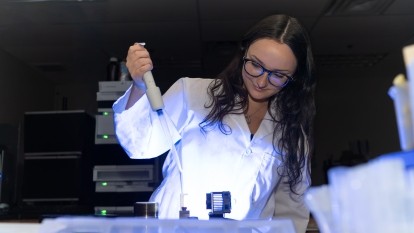
Ms. Evans, an honour chemistry student from Hammonds Plains, NS, says she’s always been interested in sustainable chemistry, so being able to have this experience in a lab setting was a wonderful opportunity. Her research explores the potential of producing ammonia through the photocatalytic reduction of nitro-containing compounds, with the broader goal of developing more sustainable approaches to fertilizer production.
“I was especially interested in the connection between chemistry and environmental sustainability, and I liked that this project allowed me to work on a problem with a much larger real-world application. The possibility of using light-driven chemistry to develop more sustainable methods for producing important chemicals was something that really drew me to the project.”
Discovering how much there is to learn from an experiment that doesn’t necessarily work the way you expect was one of the most interesting aspects. She quickly learned that a huge part of research is troubleshooting, adapting, and trying to understand why something happened.

“This experience as a whole has completely changed my confidence as a science student. I started my research being very unsure of myself and feeling a little out of place because of imposter syndrome. However, having the opportunity to conduct my own research has allowed me to see what I’m capable of beyond a classroom setting. I’ve become much more comfortable working independently and thinking like a researcher rather than just trying to find the ‘right’ answer.”
Ms. Evans also thanked her supervisor, Dr. Geniece Hallett-Tapley.
“She’s such a patient and wonderful supervisor, and I truly couldn’t have been luckier to have the opportunity to work in her lab. She was always willing to explain things I didn’t understand, answer my questions, and give me the independence to learn and adapt for myself. I learned so much from her throughout the experience and I’m very grateful.”
IMPACTING WOMEN’S HEALTH
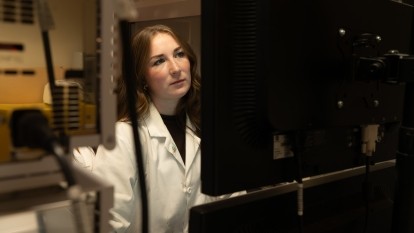
Ms. MacPhee an honours chemistry student from Hammonds Plains, NS also worked under the supervision of Dr. Hallett-Tapley. She focused on aqueous pollutant remediation, specifically targeting pharmaceutical pollutants which negatively impact women’s health, such as Estradiol. These pollutants, she says, cause the feminization of aquaculture, detrimental to many ecosystems.
“What sparked my interest in this research topic is the involvement in women’s health, as well as methods of sustainable chemistry that I hadn’t heard of before. Women’s health is of particular interest to me, it being as under researched as it is,” she says.
“The molecules that I work with directly increase the risk of developing hormonal imbalances, infertility, and breast cancer. These molecules are found in common waterways, often because of improper pharmaceutical disposal. As a result, the autonomy of being exposed is taken away, and these risks become more prevalent.”
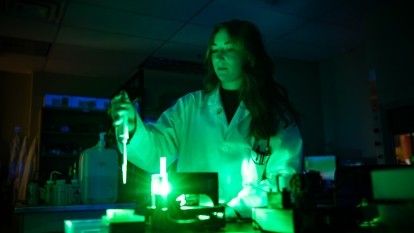
Ms. MacPhee says being able to aid in the breakdown of the molecules to help solve this issue is important to her, especially as this issue is often overlooked.
“Using photochemistry to do so was also something new to me, and the aspect of using visible light as a tool to break down harmful molecules is a valuable step towards sustainable degradation methods.”
Working on a project and being able to dive headfirst into it while working closely with a supervisor is a great experience and something she is grateful for. Ms. MacPhee says she grew as a researcher, learned to step out of her comfort zone, found it rewarding to work with others in the lab, and developed resiliency.
COATING OVER FREEZER FOODS
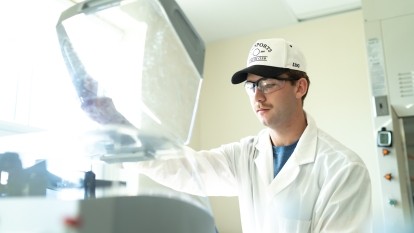
“It was an honour to be selected for this award. Working in research gives you an edge like no other. The difference in my ability to grasp ideas in my third year compared to my fourth year is unbelievable,” says Mr. Burton of Irishtown, NL, a fourth year chemistry student who is also completing a minor in math and a concentration in biochemistry.
His research is concentrated on water and freezing properties that ice has when certain molecules (non-permeable cryoprotectant molecules) are introduced in the system. He says the reason these are called cryoprotectants is because they help to stop ice from forming so easily.
“We are trying to grasp more understanding in how these molecules can be used in solution as a coating over freezer foods to stop freezer burning. As an avid moose hunter from Newfoundland, we hunt our moose and take all the meat. There is so much meat that some tend to stay in the freezer for a while, which could then become ‘freezer burnt’ and inedible. With a cryoprotectant solution the freezing of the meat can occur over a longer period of time so all can be consumed with none to waste.’
Mr. Burton says being able to dive deep into such an interesting topic and using high tech machinery was a tremendous benefit. Doing research, he says also shifts your brain to think in a more detail oriented way.
Mr. Burton was supervised by Dr. M. Shajahan Gulam-Razul and Dr. Gerrard Marangoni, who he describes as “two extraordinary physical chemists both with over 20 years’ experience.” He describes them as “two big reasons why everyone should choose StFX chemistry when looking for a post high school program to attend.”