

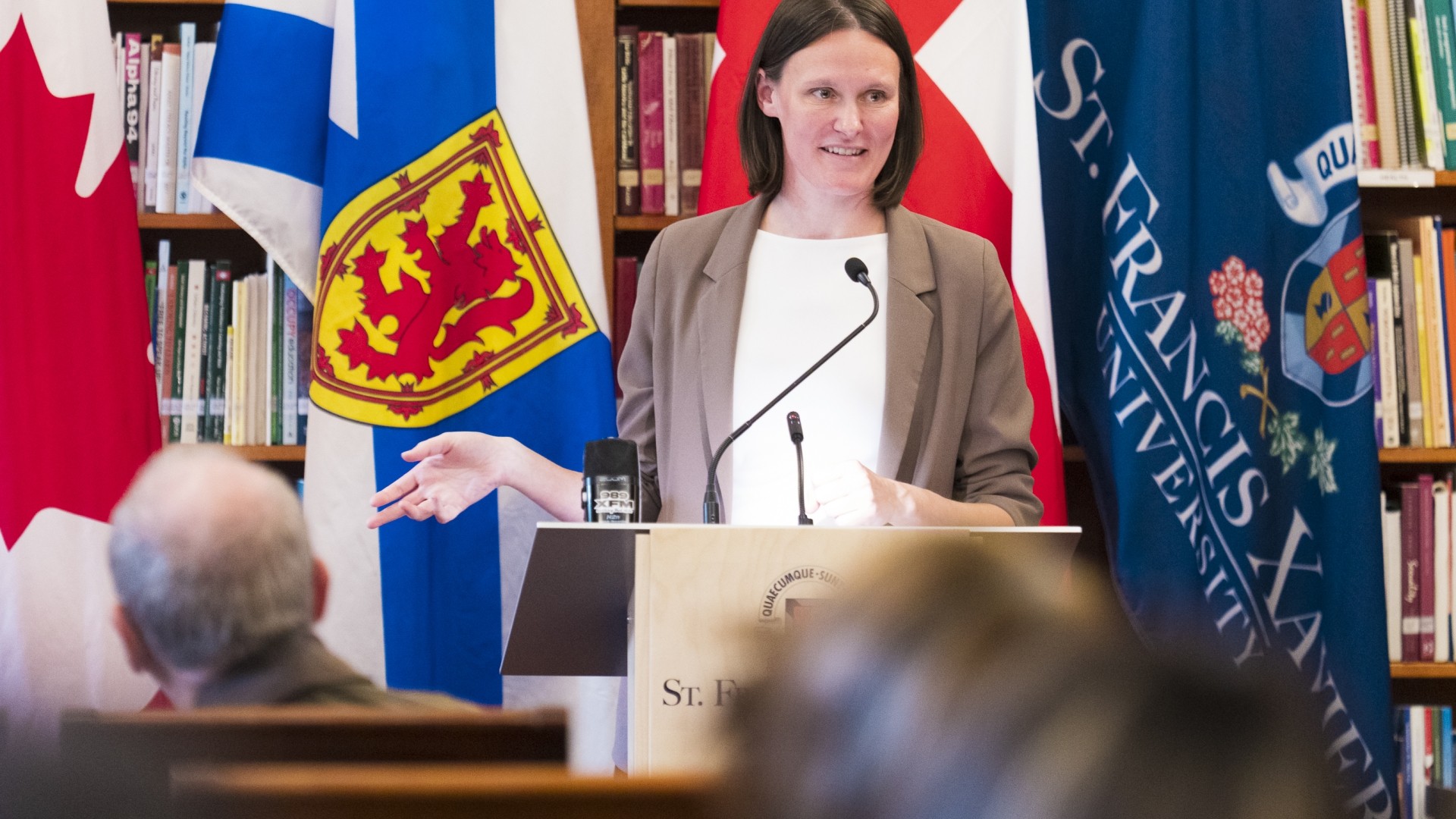
St. Francis Xavier University researcher Dr. Erin Mazerolle has been named a Tier II Canada Research Chair (CRC) in Brain Health Literacy. It’s a five-year, federally funded position aimed at helping Canadians better understand and manage brain health, with a particular focus on addressing challenges in housing, education, and aging.
The chair comes with a federal investment of $500,000 over five years, plus an annual $20,000 research stipend.
Jaime Battiste, Parliamentary Secretary to the Minister of Crown-Indigenous Relations and Member of Parliament for Cape Breton–Canso–Antigonish, was at StFX on September 10, 2026, to make the announcement during a well-attended ceremony at the Coady Institute Marie Michael Library.

“Tier II SSHRC Canada Research Chairs are for exceptional, emerging researchers,” Mr. Battiste said, as he noted the importance of Dr. Mazerolle's work in bringing medical care to people in their own communities, and the frontline insights this work will bring.
StFX Academic Vice-President & Provost Dr. Amanda Cockshutt also offered congratulations and spoke to the value the CRC program brings to a university like StFX, which currently holds one Tier I and four Tier II Canada Research Chairs.
“This really builds our capacity,” Dr. Cockshutt said. These research positions generate new knowledge that can help solve real-world problems, she noted, while creating more opportunities for students, and strengthening the university as a whole. “That helps everything we do.”
Dr. Cockshutt added that StFX has also been allocated two new Tier I Canada Research Chairs.
The ceremony was emceed by Dr. Erin Morton, StFX Associate Vice-President, Research, Graduate, and Professional Studies.
BUILDING BRAIN HEALTH LITERACY
“I'm so excited and grateful for the opportunity to contribute…to help people gain the knowledge and skills they need to take control of their brain health,” Dr. Mazerolle told the crowd.
Dr. Mazerolle, a psychologist and associate professor in StFX's Department of Psychology, studies how people learn about the brain, and how that knowledge can translate into meaningful health improvements, both individually and nationally.

“Brain health literacy is about much more than understanding how the brain works,” she said. “It is about ensuring that Canadians can benefit from the remarkable advances we are making in neuroscience, and that communities have the knowledge they need to respond effectively to issues affecting people with cognitive impairments.”
Rates of cognitive impairment, such as thinking and memory problems, continue to rise globally, and are reaching crisis levels in countries with aging populations such as Canada, Dr. Mazerolle says. While fundamental neuroscience and health research can help answer questions about the causes of such impairment, she says that generating widespread public impact requires social science, community-based, and educational approaches, methods that help counter health misinformation, improve the social determinants of health, and enable people with cognitive impairment to help shape the research that affects them.
Dr. Mazerolle works closely with students, people with lived and living experience of brain-associated conditions, and community organizations toward these goals. Current and upcoming projects include a tabletop game designed to build brain health literacy in youth, exploring how research can better engage individuals with cognitive impairment, and co-creating an educational video series on vascular cognitive impairment.
ADDRESSING GAPS IN HOUSING, EDUCATION, AND AGING
Her research program will begin by surveying Canadians to establish a comprehensive picture of the current state of brain health literacy. She will then identify best practices for teaching the public about the brain and apply those approaches to address gaps in brain health literacy related to housing, education, and aging.
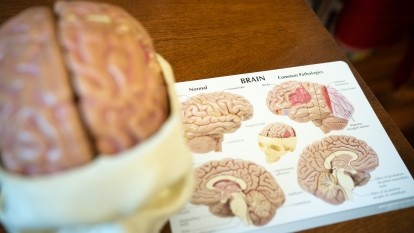
The research has important implications for people living with brain injuries and cognitive impairments. For example, more than half of people experiencing housing instability have experienced brain injury, yet many housing support programs are not designed with cognitive impairments in mind. Complex paperwork, for example, can create additional barriers for people who have experienced a brain injury.
Dr. Mazerolle’s research will examine how greater brain health literacy can help communities better understand these challenges and inform policies, programs and services that are more responsive to the needs of people with cognitive impairments.
Dr. Mazerolle’s work also includes research into “SuperAgers,” those older adults who maintain exceptionally strong memory and cognitive abilities as they age. By studying these individuals and examining the factors associated with healthy cognitive aging, her research seeks to contribute to a better understanding of how brain health can be maintained across the lifespan.
Her broader work includes developing more accessible approaches and technologies for assessing brain health, with the goal of making brain health research and assessment more accessible to Canadians, including those living in rural and underserved communities.

A central component of the new CRC program will be collaboration with community members and people with lived and living experience.
“Co-creation is at the heart of this research,” says Dr. Mazerolle. “We want to work alongside the people and communities who are directly affected by these issues. Their experiences and perspectives will help shape our research questions, our methods and the outcomes we measure.”
By improving brain health literacy among Canadians, Dr. Mazerolle’s research has the potential to improve individual health outcomes and contribute to public health in Canada and beyond. It could also help address broader challenges, including housing instability and inequities in education, while helping ensure that society can benefit from advances in neuroscience.
The best practices developed through the research program could be adapted to other areas of health literacy and adopted internationally, positioning Canada as a leader in brain health literacy research.