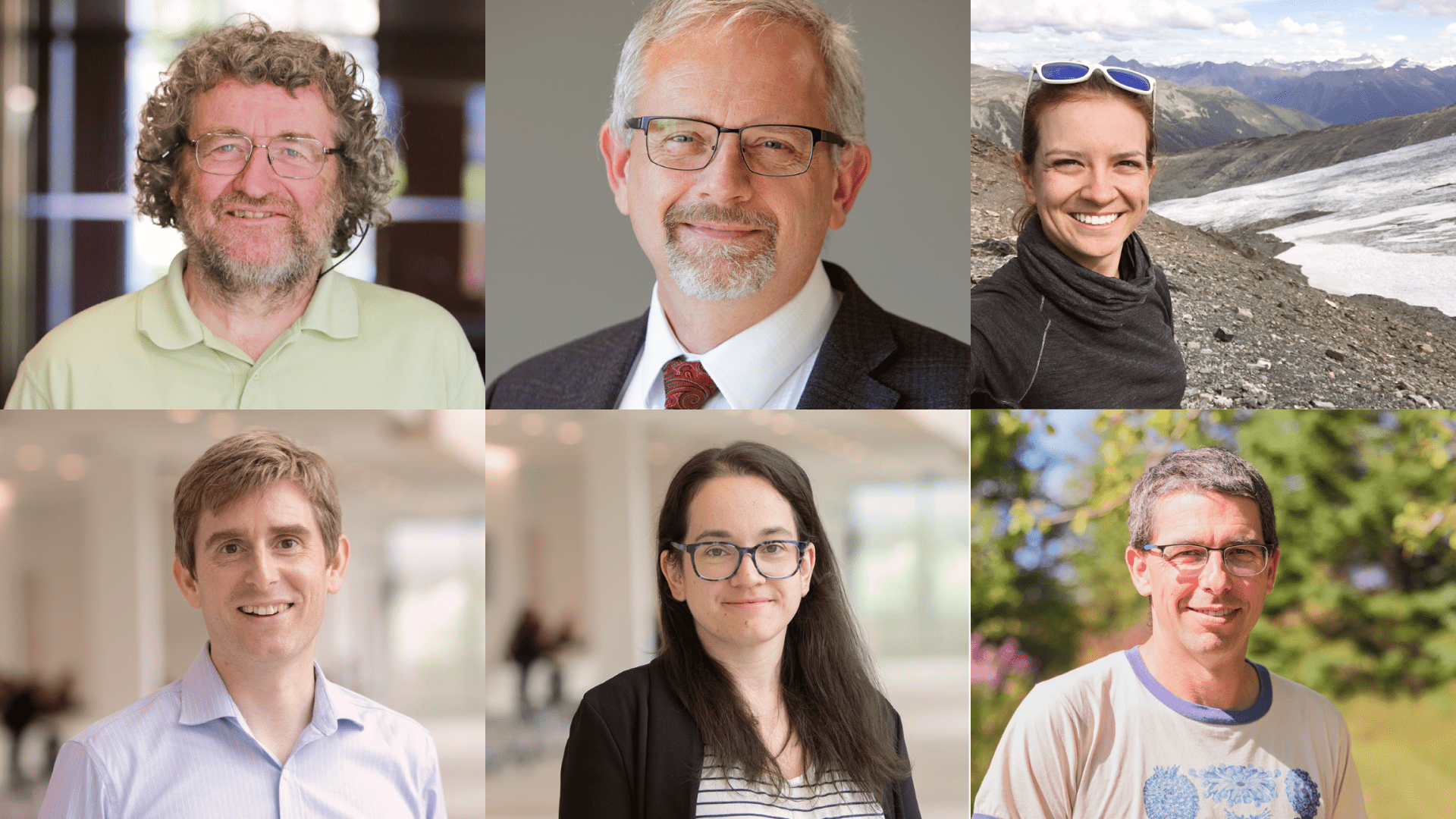
Six researchers at St. Francis Xavier University have received funding through the Natural Sciences and Engineering Research Council of Canada (NSERC) Discovery Grants program, supporting innovative research that addresses some of today's most significant scientific and environmental challenges.
More than $1 million has been announced by the Minister of Innovation, Science and Industry, the Honourable Mélanie Joly, in research funding over the coming years, enabling StFX researchers to advance knowledge in environmental science, biology, earth sciences, mathematics, and statistics while training the next generation of scientists.
Three researchers also received NSERC's Discovery Launch Supplement, providing an additional one-time award of $12,500 to help establish their research programs.
“This funding recognizes the exceptional quality and impact of research being conducted at StFX," said Dr. Erin Morton, Associate VP Research, Graduate and Professional Studies. "Our researchers are addressing critical questions ranging from climate change and ecosystem resilience to Earth's evolution and the fundamental laws of physics. These grants will support discoveries that benefit both scientific understanding and society while providing invaluable research opportunities for students.”
2026 NSERC Discovery Grant Recipients
Dr. Heather Penney, Aquatic Resources Program, received $38,000 annually for five years for her project, Impacts of habitat loss and multiple stressors on the distribution and reproductive ecology of ribbed mussels. Dr. Penney also received a $12,500 Discovery Launch Supplement.
Her research investigates how climate change and salt marsh degradation affect ribbed mussels, a key ecosystem engineer in Atlantic Canada's coastal marshes. By examining habitat loss, reproductive ecology, and future climate scenarios, the research will help inform conservation and restoration strategies for vulnerable coastal ecosystems.
Dr. Russell Wyeth, Department of Biology, received $48,000 annually for five years for Neuroethology of Chemical and Flow-based Navigation in Aquatic Gastropods.
Dr. Wyeth's research explores how aquatic snails and sea slugs navigate using chemical cues and changing water currents. By combining behavioural studies with neuroscience, his team aims to better understand how nervous systems process environmental information to guide movement, with implications for understanding navigation across the animal kingdom.
Dr. Jesse McNichol, Department of Biology, received $38,000 annually for five years for Quantifying Resilience of Microbial Sulfur Detoxification to Water Column Overturning in a Coastal Euxinic Basin. He also received a $12,500 Discovery Launch Supplement.
His research focuses on microorganisms that naturally detoxify hydrogen sulfide in oxygen-depleted marine environments. As climate change increases the frequency of low-oxygen coastal waters, this work will improve understanding of microbial resilience and help predict the future health of Atlantic Canada's coastal ecosystems.
Dr. Celeste Cunningham, Department of Earth and Environmental Sciences, received $35,000 annually for five years for Transport and Depositional Dynamics of Marine Organic-Rich Sediments and Their Role in Oceanic Carbon Cycling, along with a Northern Research Supplement of $17,335 annually for five years and a $12,500 Discovery Launch Supplement.
Her research examines how organic carbon is transported and preserved in marine sediments, improving understanding of Earth's long-term carbon cycle and the geological processes that influence climate over millions of years. Field research in Nunavut, Yukon, and modern marine environments will help bridge knowledge between ancient and present-day carbon cycling.
Dr. Brendan Murphy, Department of Earth and Environmental Sciences, received $44,000 annually for five years for Origin and Emplacement of Trans-crustal Batholiths: Implications for Crustal Growth.
Dr. Murphy's project investigates how continents formed through ancient geological processes. By studying deep crustal magmatic systems, his research will improve understanding of continental growth, Earth's chemical evolution, and the geological processes that influence natural resources.
Dr. Robert van den Hoogen, Department of Mathematics and Statistics, received a Discovery Development Grant of $22,000 annually for two years for Symmetries in Alternative Theories of Gravity; Working towards an Averaged Theory of Gravity.
Dr. van den Hoogen's research program examines fundamental questions in theoretical physics, including the development of new approaches to gravity that could help explain the "Hubble tension"—one of modern cosmology's most significant unresolved problems.
NSERC Discovery Grants provide long-term support for ongoing research programs in the natural sciences and engineering. The program recognizes excellence in research and enables Canadian researchers to pursue innovative discoveries while mentoring undergraduate and graduate students.