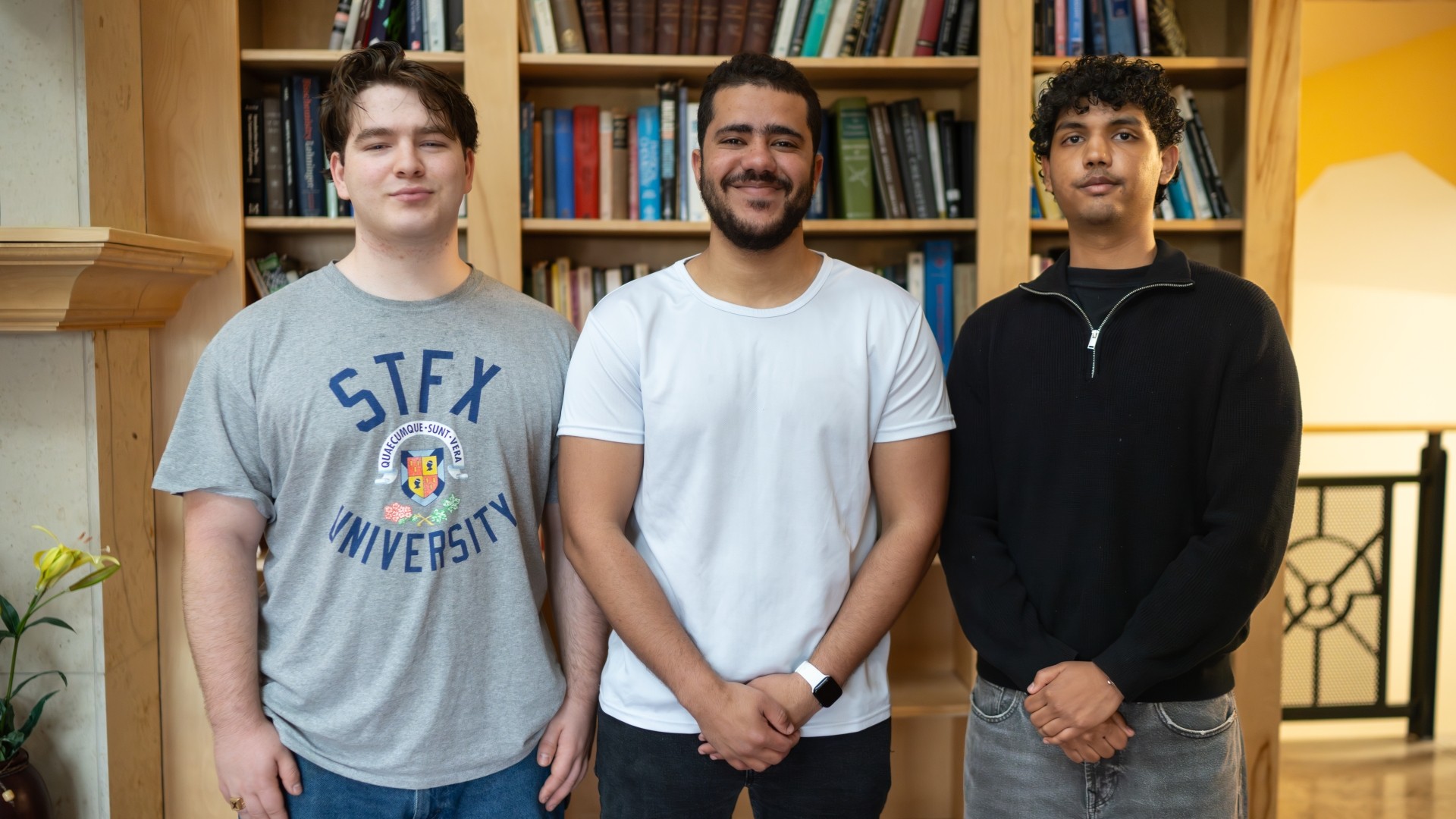
A team of four students from St. Francis Xavier University, Youssoff Abdallah, John Kendall, Dylan Clark, and Neel Gopaul, achieved an impressive fourth place finish in the East of Canada regional round of the Mastercard Capture the Flag (CTF) Series 2026 organized by the National Cybersecurity Consortium.
The event is designed to simulate real-world cyberattacks and defenses in a controlled environment. The competition allows students to apply theoretical knowledge to practical scenarios, often working individually or in teams to solve a series of progressively challenging problems.
“For our students to achieve a fourth place in their very first participation is an excellent accomplishment,” says StFX computer science professor Dr. Tasneem Darwish. “They demonstrated strong dedication by preparing extensively, spending many hours practicing and working on similar challenges in advance of the competition. Their effort and commitment were clearly reflected in their performance. I am very proud of their achievement and the level of professionalism they displayed throughout the event.”
As part of the competition, students typically engage in tasks such as identifying and exploiting vulnerabilities in web applications, systems, or networks; reverse engineering software to uncover hidden functionality or security flaws; cryptography challenges, where they analyze and break encryption schemes or decode hidden messages; digital forensics, involving the investigation of logs, files, or memory dumps to uncover evidence; and binary exploitation and scripting, where they write code to automate attacks or extract sensitive data.
Each challenge is designed to mimic real-world cybersecurity threats, encouraging students to think like both attackers and defenders. They must analyze the problem, apply appropriate tools and techniques, and ultimately retrieve a “flag,” a hidden piece of data, as proof of success.
Beyond technical skills, the competition also helps develop critical thinking, problem-solving, teamwork, and time management, says Dr. Darwish, as participants work under time constraints and often collaborate to tackle complex challenges.
“Overall, the Mastercard CTF is an excellent opportunity for students to gain practical cybersecurity experience, deepen their understanding of system vulnerabilities, and prepare for careers in areas such as ethical hacking, security analysis, and digital forensics.”
The national final of the competition takes place in June.