


Campus to Community: Sharing stories from our ongoing connections
St. Francis Xavier University doesn't stop at the edge of campus. Campus to Community is an ongoing series highlighting the deep ties between StFX and the communities it serves. We’re shining a light on these relationships--from research labs and global outreach, to service and shared purpose--and how they help shape and strengthen both. To see the full series, please see HERE.
Dr. Greg Hadley working with Nova Scotia entrepreneurs to explore how schools can build entrepreneurial mindsets
During his decade as a high school teacher in rural Nova Scotia, Dr. Greg Hadley taught during a period of significant outmigration when schools were closing and families leaving the area. It left him with an important question that would shape the next phase of his career: how do you educate students to give them a sense of self-determination that they see a future in rural communities.
That question in part recently sent Dr. Hadley, now Chair in Entrepreneurship Education in StFX's Faculty of Education, and his research team driving across the province, from Cape Breton to the South Shore, to sit down with young entrepreneurs and ask what role, if any, school had played in shaping them.
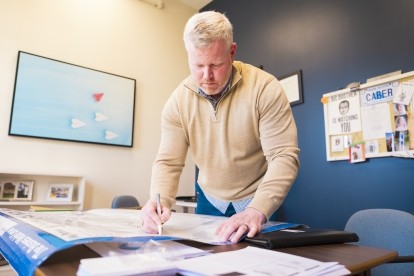
“The project was designed to explore how schools can develop an entrepreneurial way of being, what they’re doing or not doing to create these conditions,” says Dr. Hadley, who spent months interviewing 10 young, successful entrepreneurs from across the province, each no more than a decade removed from high school and each who’d been running a successful venture.
The SSHRC-funded work sought to understand their experience with a broader goal of understanding how schools help cultivate entrepreneurial students.
“The project revealed interesting insights into their experiences,” he notes.
For the most part, schools weren't a huge influence. The entrepreneurs he spoke with credited their education with building interpersonal skills and the ability to work with others. But the strongest influences they noted were external factors including family and mentors, and internally, a drive to be their own boss, be creative, and take control of their professional lives.
The project's major conclusion is that schools need to create better conditions for students to develop an entrepreneurial mindset, including more content tied to creativity, problem-solving, collaboration, financial literacy and some elements of competition, he says.
Overall, schools need to be less prescriptive and provide time and space for students to learn in news ways and try new things.

Nationally, he's seen growing recognition that students need to leave school with skills like organization, persistence, and problem-solving, regardless of whether they ever start a business. Entrepreneurship, he says, isn't necessarily about founding a company; it's a way of being, built on a universal set of skills of tremendous value.
A study that build a community
One entrepreneur who took part in that original research was Alex MacLean, CEO of East Coast Lifestyle. The connection didn't end when the interview did. Mr. MacLean recently reached out to Dr. Hadley about a new market research project, and this fall, Dr. Hadley, together with Schwartz School of Business professor Dr. Neil Maltby, is working on a comprehensive study with the Nova Scotia brand.
It's one of several ripple effects Dr. Hadley didn't anticipate when the project began.
“It's created deep connections to Nova Scotia business," he says. "It's created other research avenues.” Several of the entrepreneurs he first interviewed have since visited his classes to speak with students, and some have taken part in Impact-X, a two-day summit on social entrepreneurship, at StFX.
Dr. Hadley also launched a YouTube channel, http://www.youtube.com/@teachingentrepreneurship, featuring edited conversations with the entrepreneurs, spotlighting their businesses alongside the research findings. Videos of additional entrepreneur interviews are still being added. People have reached out from around the world after viewing the channel.

“It's a fun way to make research available to a wider audience, and to have an impact, which was important,” he says.
He has published two academic journal articles from the project and presented the findings at both academic and practitioner conferences. Dr. Hadley also works closely with the Department of Education, in particular a division called Career Pathways, on curriculum review and consulting. He describes it as a strong, supportive relationship. The department has also helped promote and amplify his work across the province.
Within the Faculty of Education, Dr. Hadley teaches entrepreneurship education, and students can graduate with a teachable in business education, carrying that same thinking into their own future classrooms. Working with student entrepreneurs remains one of the most rewarding parts of the job.
“It's always a delight to work with student entrepreneurs,” he says. “Engagement is at a high level. It allows them to unlock skills they didn't know they had.”
Dr. Hadley is hopeful the work will lead to a second phase of the original study, and even more chances to connect classrooms with Nova Scotia entrepreneurs.