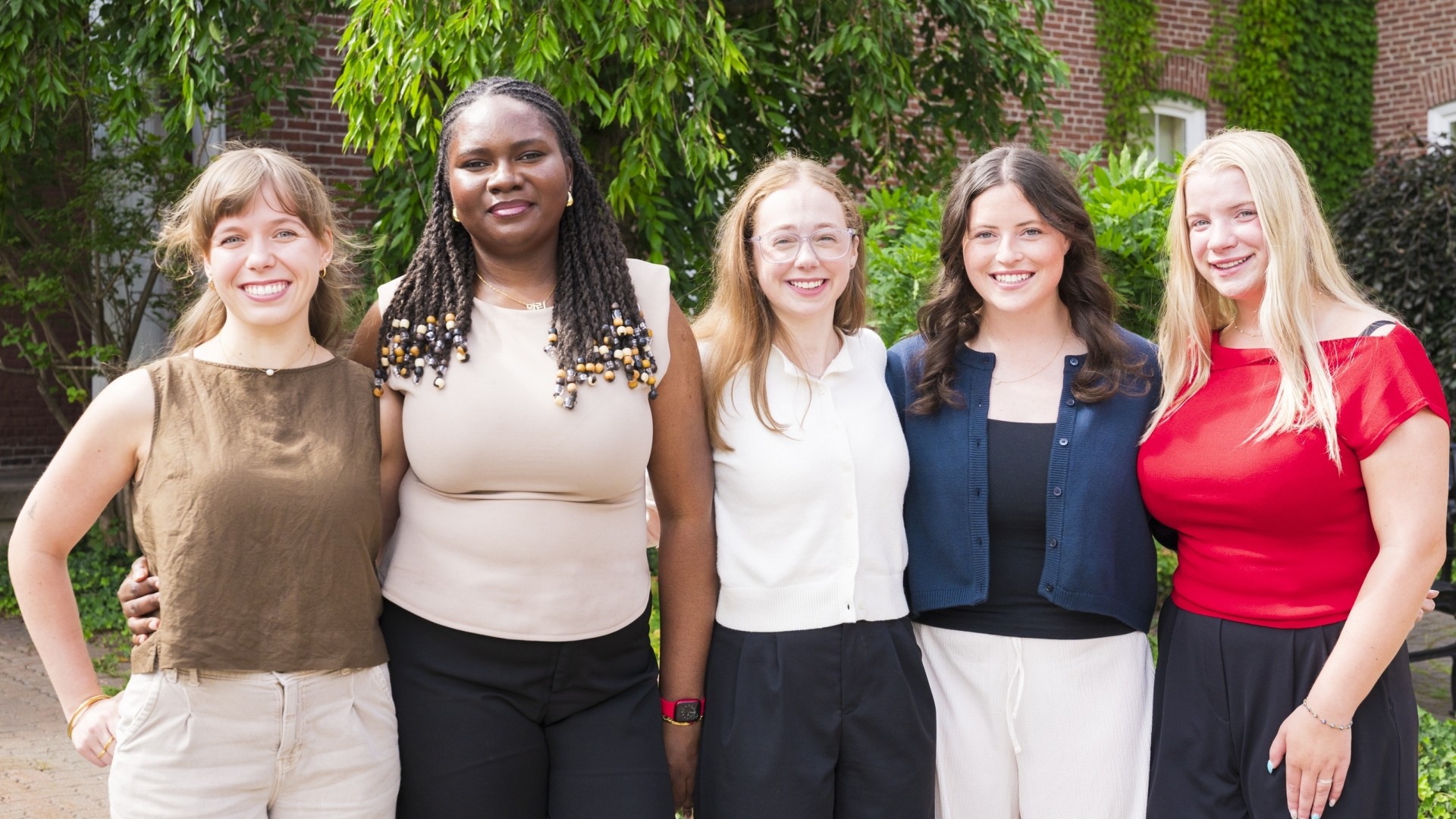
Seven StFX students spent their summer digging into important questions, from the post-release experiences of formerly incarcerated women in Canada to rethinking how central banks set policy.
Kate Byrne received the John B. Stewart Political Science Research Award, while Lucy Steffler-Minty, Malynn Ishmael, Macy McDonell, Madison Weston, Jaide Russell, and Kate Benning each received the Lauder-Mulroney Research Award, which is open to students in any discipline working in public policy and governance. The awards provide $9,250 in funding for 14 weeks of research work under the supervision of a StFX faculty member.
UNDERSTANDING WHAT HAPPENS AFTER RELEASE
Lucy Steffler-Minty, a fourth year applied forensic psychology student from St. John's, NL, is working under the supervision of Dr. Elvira Prusaczyk to build an overview of post-release outcomes for formerly incarcerated women in Canada.
“What drew me most to this topic was the recognition that women involved in the justice system often face complex and intersecting challenges, yet their experiences are frequently underrepresented in research,” she says. “I wanted to better understand those experiences and contribute to evidence that could support meaningful change.”
She notes that no single comprehensive source currently exists that examines the post-release experiences of women across provinces, disciplines, demographics, and variables, a gap she hopes her project can help fill for educators, learners, and policymakers.
Her interest in supporting marginalized populations was shaped both by her studies and by her involvement with the Women and Gender Studies Society and the Elizabeth Fry Society Study Club.
For Ms. Steffler-Minty, the award has funded a summer of work and it’s helped clarify her path forward. “This experience helped me discover a passion for research that I didn't know I had, and I think that kind of insight can be incredibly valuable when making decisions about future education and career paths.”
RETHINKING EYEWITNESS TESTIMONY

Jaide Russell, a fourth year student from Clarke’s Beach, NL, is examining the causes of the ‘weapons focus effect,’ a phenomenon relevant to how police and courts handle the admissibility of eyewitness testimony.
“I became interested in this research topic after taking an introduction to forensic psychology course, which briefly touched on the weapons focus effect,” she says. “This course was taught by Dr. Chris Lively, who is now my supervisor.”
Ms. Russell says the award has let her focus her energy on her work and her passion for her studies while gaining valuable research and academic experience.
“Research awards can relieve students from the stress and pressure of full-time summer jobs, allowing them to dedicate time and energy into their research that they otherwise wouldn’t be able to. They allow students to fully immerse themselves into the research experience and commit to the work they are doing without the external financial pressures,” she says.
TRACING U.S.-ISRAEL POLICY THROUGH THE UN SECURITY COUNCIL
Kate Byrne, a fourth year honours political science student from Halifax, NS, is studying United States voting patterns in the United Nations Security Council (UNSC) in relation to Israel in the years since 9/11.
Ms. Byrne's research traces a shift in American foreign policy. “As longstanding allies, beginning under Nixon, the U.S. would exercise its veto power against any UNSC resolutions that criticized Israel’s actions in the broader Middle East,” she says. “This was fairly consistent up until the Bush administration, when the 9/11 attacks sparked a new era of anti-terrorist foreign policy, and there was a shift in wanting to democratize states as a way to prevent terrorism. Thus, Bush became the first president to call for a two-state solution and strongly supported a democratic Palestinian state, ushering in a new era in the UNSC. The U.S. no longer blindly vetoed resolutions condemning Israeli actions but instead strategically allowed for some resolutions to pass either by voting yes or abstaining from voting. By examining post-9/11 American foreign policy and UNSC activity, I hope to better understand how the U.S. uses the UNSC as a channel to advance its national interests, such as anti-terrorism and democratization, throughout the Middle East, across various administrations.”
The idea grew out of a class she took in her third year. “In the first semester of my third year, I took a class called Arab-Israeli Conflict with Dr. Jamie Levin, my now thesis supervisor, which examines the long history of conflict between Israel and the Arab states of the Middle East,” she says. Tasked with developing an original research question for that class, Ms. Byrne combined her existing interests in the UNSC and American-Israeli relations. “It was actually him who suggested I look into this further for my thesis.”
Ms. Byrne says the experience sharpened her research and time-management skills and she says these opportunities for students help build research skills, offer meaningful summer employment, and give students a taste of what a career in academia might look like.
RETHINKING HOW CENTRAL BANKS SET POLICY
Malynn Ishmael, a fourth year student from Rivers State, Nigeria, is exploring whether central banks, with a focus on the U.S. and Canada, should factor financial stability concerns when formulating monetary policy as opposed to their current on inflation targeting framework they have followed for years.
“I became interested in this topic after participating in the Bank of Canada's Governor’s Challenge for two consecutive years, where we give interest rate recommendations to the bank after studying the Canadian economy for a few months,” she says. “The policy recommendation we give must use the inflation targeting framework, and I wondered if that was optimal.”
Ms. Ishmael, who is supervised by Dr. Greg Tkacz, says an interesting thing she found was that Canada formally adopted an inflation-targeting approach about two decades before the United States did. “This surprised me since the U.S. is known to have a much larger economic and financial influence on Canada.”
The experience gave her hands-on research training, a chance to apply classroom theory, and the opportunity to learn new econometric and statistical software, she says.
It’s also changed how she thinks about her future. “I have always considered grad school after my undergraduate degree but felt wildly underprepared, but after this opportunity, I feel more confident going in, and now research work looks more interesting than scary. It also doesn't just give you the space to apply classroom knowledge but also gives you the room to learn more whilst working.”
FUNDING AND FRONTLINE WORK
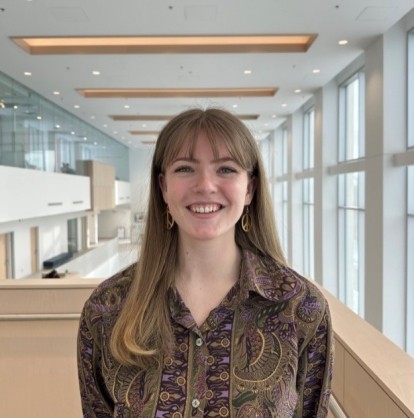
Kate Benning, a fourth year sociology student from Medicine Hat, AB, is using surveys, semi-structured interviews, and textual analysis to examine how workers at gender-based violence organizations in Nova Scotia experience and navigate funding requirements in their day-to-day work.
The project, part of her honours thesis, is still ongoing.
Ms. Benning's interest traces back to her own frontline experience. “Last summer I volunteered and worked at my local women's shelter back home in Alberta. I worked for and alongside staff who taught me so much about the invaluable work they do every day for survivors of gender-based violence, and how they are not able to provide what people need, but what is available based on funding,” says Ms. Benning, who is supervised by Dr. Katie Aubrecht.
Her literature review revealed a gap she hopes her own project can help address: much of the existing research on gender-based violence individualizes the issue, losing sight of the broader social and political forces that shape it.
“I am so grateful to receive the Lauder-Mulroney Research Award to conduct my honours thesis,” she says. “It has been a huge honour to be funded for research and have the privilege to spend the time looking into this topic and developing my project.”