

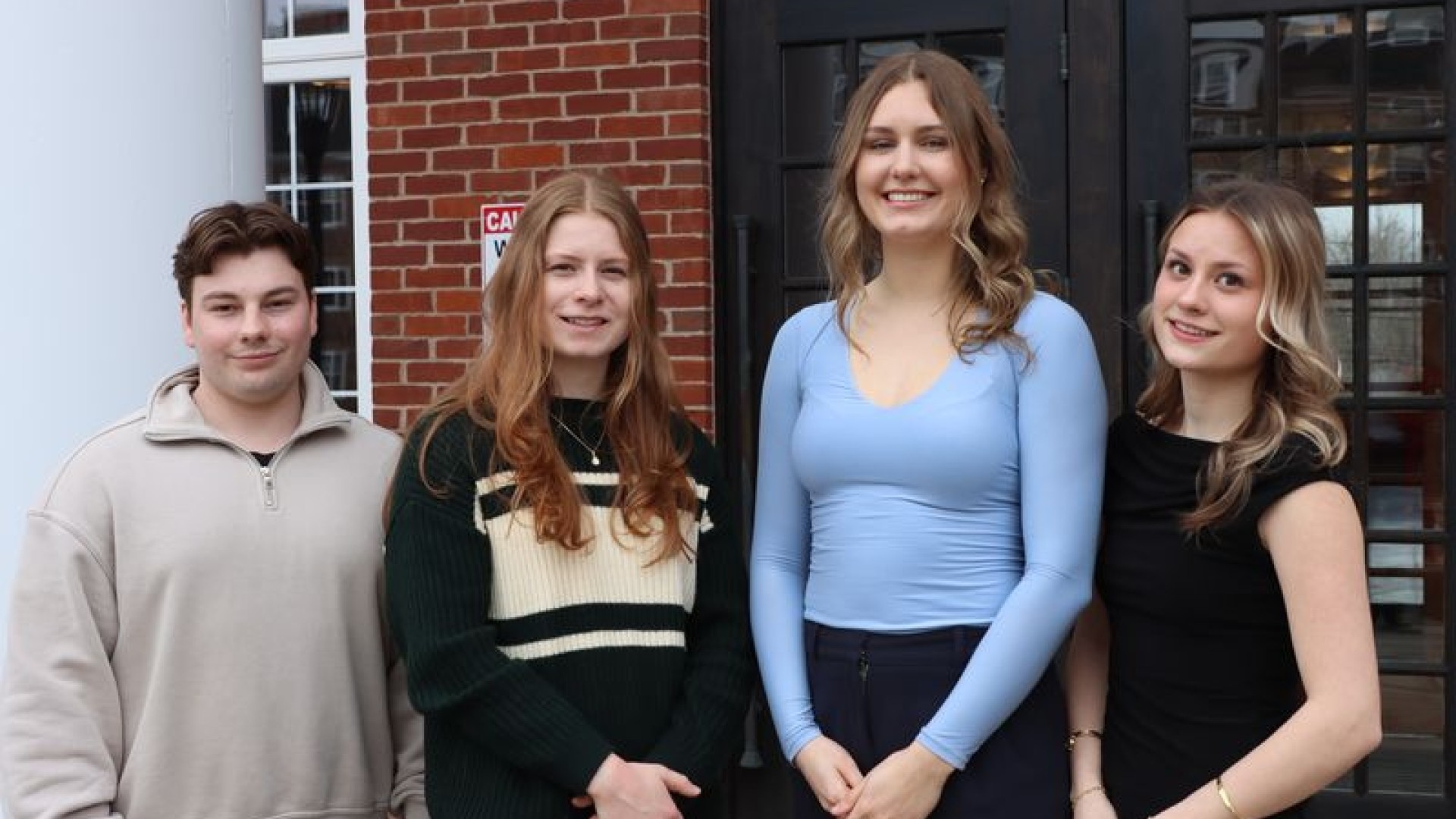
Summer student research awards at StFX do more than fund a project, they give students the freedom to explore what interests them, with the guidance of faculty supervisors. This year, four students, Olivia Harding, Reegan Bell, Ryan O’Neill, and Joanna Martinsen, worked on research projects from better understanding endometriosis and colorectal cancer screening to psychological safety among 2SLGBTQ+ university students in social environments where alcohol or other substances may be present, to microbial life in the Bras d'Or Lakes.
The students were all recipients of the StFX Open Research Award. Each award, which carries a value of $9,250, supports student projects in any discipline or field of research.
BETTER UNDERSTAND ENDOMETRIOSIS
“Having the financial support from the summer research award, along with the guidance and trust of my professors to pursue a topic that I am so passionate about and that is very close to home for me, has been incredibly meaningful,” says Olivia Harding of Lethbridge, AB, a fourth year health student, taking a concentration in biomedical sciences.
Her research seeks to better understand the experiences of young people living with endometriosis, a complex and chronic condition where tissue similar to the uterine lining grows outside of the uterus, often causing severe pain and significant health challenges.
Despite affecting millions of people worldwide, she says endometriosis remains under-recognized and frequently misdiagnosed. It can have profound impacts on physical and emotional wellbeing, education, employment, relationships, and daily functioning, and many individuals experience prolonged diagnostic delays, symptom dismissal, stigma, and limited access to appropriate care.
She says this incredible student research experience allowed her to turn a personal part of her life into an opportunity to advocate for others.
“My passion for health advocacy is deeply personal, shaped by living with chronic illness from a young age and experiencing firsthand the profound burden that endometriosis can place on individuals. My experience managing endometriosis as a university student, navigating the healthcare system, and advocating for care despite limited support has driven my determination to advance research, awareness, and support for this underfunded and misunderstood condition.”
Ms. Harding, who is supervised by Dr. Kara Thompson, says it has been eye-opening to learn more about a condition that she has lived with for so long.
“Through the interviews, I hope to not only learn from others’ experiences but also offer resources that help individuals feel empowered and supported in seeking further care. I also hope this research can help create a community on campus where people can support one another while navigating this condition and feel less isolated.”
STRENGTHENED SKILLS, CONFIDENCE
“This experience has impacted me greatly, and I am incredibly grateful for the opportunity to have worked on a funded summer research project alongside my supervisors,” says Ryan O’Neill of Calgary, AB, entering his third year of an honours applied forensic psychology degree.
“My long-term goal is to apply to clinical psychology graduate programs across Canada and having the opportunity to be recognized as a promising emerging researcher while still only in my second year of university has been invaluable. This experience has not only strengthened my research skills and confidence but has also reinforced my interest in pursuing research as an important part of my future career.”
He describes his research interests as at the intersection of emerging adulthood, mental health service delivery, and substance use. “My current project looks at psychological safety among 2SLGBTQ+ university students in social environments where alcohol or other substances may be present. More specifically, I’m interested in how masculine norms and expectations within these environments may influence how safe, included, or anxious someone feels.”
He wanted to bridge a gap in the existing literature as it relates to social environments, mental health, and identity. He’s hoping to better understand which aspects of a social environment contribute to identity-based distress and whether factors such as inclusive behaviour, allyship, and bystander responses can help protect psychological safety.
Mr. O’Neill had two supervisors on the project. His primary supervisor was Dr. Katelynn Carter-Rogers, with Dr. Elvira Prusaczyk as his secondary supervisor. He is currently a lab member of the Prejudice Awareness Reduction (PAR) Lab, led by Dr. Prusaczyk.
BECOME COMFORTABLE WITH UNCERTAINTY
Joanna Martinsen, a fourth year student from Thunder Bay, ON, worked with Dr. Jesse McNichol this summer, studying a sulfur-detoxifying clade of bacteria known as SUP05 present within an anoxic basin in the Bras d’Or Lakes. She used cultivation-based and bioinformatic approaches to learn more about their diversity and distribution, attempting to better understand their role in the ecosystem.
“My results suggest that one genome within this clade may have dominated over others in the ecosystem across depth and time. This means that the SUP05 population in this ecosystem may be less diverse than I expected,” she says.
Ms. Martinsen says taking an introductory course and lab in microbiology led her to become curious about the methods that microbial ecologists use to study incredibly complex microbial communities. This experience gave her insight into what the process of research looks like.
“It also allowed me to become comfortable with uncertainty, and to adapt my approaches when things did not work as expected,” she says. Not only do these awards allow students to experience the process of research firsthand, she says they provide opportunities for students to build relationships with and learn from experienced supervisors and peers.
CORRECTAL CANCER SCREENING
Reegan Bell of Perth, ON, a fourth year Bachelor of Arts and Science in Health student taking a concentration in biomedical sciences, is looking at emotional barriers to colorectal cancer screening in Canada, specifically the roles of embarrassment and disgust associated with the screening process.
Under the supervision of Dr. Arlinda Ruco, she is conducting a cross-sectional survey of Canadians aged 45–74 to better understand how these emotional barriers may contribute to people choosing not to participate. Ultimately, her aim is to support the lab's efforts in developing future screening interventions that address these emotional barriers and encourage greater participation in colorectal cancer screening.
“My health courses at StFX sparked my interest in public health and preventive healthcare, and after learning more about the Ruco Lab’s work, I became particularly interested in the role that cancer screening can play in the early detection and prevention of disease. Given the high prevalence of colorectal cancer in Canada, I was surprised by the relatively low uptake of colorectal cancer screening.”
Ms. Bell says she’s had multiple family members affected by cancer, so the research is particularly meaningful to her.
She says opportunities like this are so valuable because they allow students to work on meaningful projects, gain experience, get a head start on honours theses and explore potential career and research interests. “Another great part of the experience is being able to form relationships with supervisors and other lab and faculty members, and it’s really awesome to be a part of that community.”