

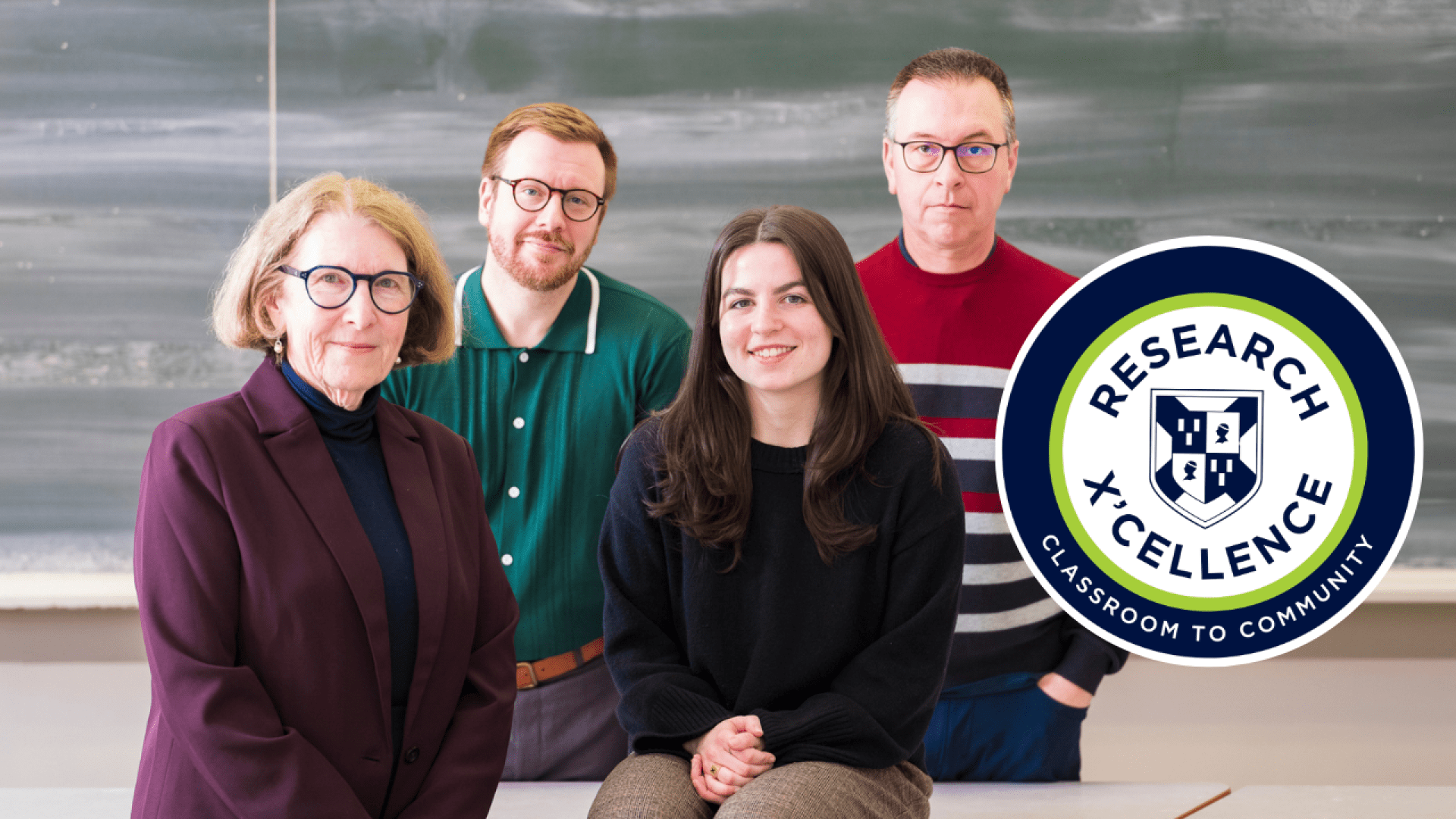
Research X’cellence: Our StFX community leveraging expertise on today’s most pressing challenges. At StFX, innovative research and creative activity are benefiting our communities, addressing some of today’s most pressing challenges. Research X’cellence shines a spotlight on members of our inspiring educational community and the impact they’re making. (To see the full series, please click HERE.)
How an RCMP Detachment and StFX faculty and students are addressing intimate partner violence, declared an epidemic in Nova Scotia
Dr. Margo Watt, a Senior Research Professor, Professor Emerita, and faculty member in StFX Applied Forensics Psychology, doesn’t usually get calls from the RCMP. So, when Sgt. Warren McBeath reached out with an unusual question about two decades worth of handwritten police logbooks documenting arrests related to intimate partner violence (IPV), she knew something unusual was beginning. “Is there something we could do with this?” Sgt. McBeath wondered on the information that had never been digitized or systematically analyzed. Five years later, that question has grown into a rare partnership between the Antigonish County District RCMP and St. Francis Xavier University—one that is educating students, informing policing practice, and addressing issues surrounding IPV; what has now been declared an epidemic in Nova Scotia.
Sgt. McBeath says from a police perspective, the value of the data was clear. The logbooks contained information that could reveal insights and trends over time that could be transformative.
“More than being reactionary, it gives us more of an opportunity to get out in front of it in terms of community policing and partnering with organizations in helping them on the preventative and educational side,” Sgt. McBeath says.
Access to police data is tightly controlled, and for good reason, says Sgt. McBeath, who had previously worked in the RCMP’s Access to Information and Privacy office in Ottawa. His background was critical in understanding the protocols, approvals, and safeguards required to move forward ethically and securely.
The data shared with researchers was deliberately low risk and controllable: it didn’t include any identifying information or youth offenders, only general variables such as age and gender. Still, the process was rigorous, and it offered a learning experience for students.
Dr. Watt says students didn’t just learn how to analyze data, they also learned about responsibility, ethics, and the real-world consequences of research.
Dr. Christopher Lively, also a faculty member in StFX Applied Forensics Psychology, is co-investigator on this project. He and Dr. Watt say IPV is not their primary areas of research, but note how the partnership has evolved into rich, informative work that is relevant within their areas of clinical- and forensic-psychology.
Both stress this partnership has only been possible because of Sgt. McBeath, whose involvement in the research has been instrumental.
Since 2021, eight StFX students have been involved in digitizing and coding the RCMP’s manual logbooks, a process that is transforming decades of handwritten notes into a usable dataset.
The students gained employment, specialized training, and career-shaping experience. The RCMP gained fresh perspectives, enthusiasm, and evidence to help guide practice.
“As far as I know, we’re the only detachment in the country doing something like this,” Sgt. McBeath says.
Dr. Lively describes the collaboration as a model academic–practitioner partnership. “It’s evidence informing practice and practice informing evidence,” he says.
The project has supported multiple honours theses, each examining domestic violence through a different lens.
Of note, former honours student Andrew MacPherson examined trends and patterns in different offence types and arrestee profiles. He went on to complete a master’s degree in experimental psychology at Memorial University and now works in miliary intelligence. Last year, Alannah Ingles utilized the police arrestee dataset and examined domestic violence trends before and during the COVID-19 pandemic. She is now a master’s student in social work at Dalhousie University.
Current honours student Abigail Jessome is examining the Ontario Domestic Assault Risk Assessment (ODARA), a tool used by police across Nova Scotia to assess the likelihood that someone charged with crimes related to IPV (e.g., assault) will reoffend. The tool’s predictive validity is based on a list of valuable static factors (e.g., criminal history) that are assessed by police officers during IPV related calls. Ms. Jessome’s research explores whether incorporating more dynamic risk factors—such as anger control and personality traits—could further improve the tool’s predictive accuracy.
Ms. Jessome has spent two summers working inside the Antigonish RCMP detachment, reviewing IPV files under strict security clearance and supervision. This past summer, her work was supported by the Irving Oil Research Mentorship Award, which allowed her to devote time to data collection.
“Being in the detachment, talking to officers, having them ask questions and show genuine interest in the research, it’s been incredibly motivating,” says Ms. Jessome, who has accepted an offer from Dalhousie Law School to continue her studies in law. Reading these files has also helped increase her compassion, she notes, as it increased her awareness that you never know what people are going through.
Dr. Watt and Dr. Lively have received multi-year research grants for this work, including two Partnership Engagement Grants (PEG) from the Social Sciences and Humanities Research Council of Canada.
In September 2024, the Nova Scotia government officially declared IPV an epidemic.
“From our perspective, if we could see meaningful reductions and increased safety, if we can better focus our limited resources, that would be wonderful,” Sgt. McBeath says.
Says Dr. Watt, “When you do research, you have an obligation to aspire to make a difference. We try to impress on students that this is important. In this case, it is to target the epidemic that is intimate partner violence. You’re educating.
“That’s what it rests on, education. That’s what we’re trying to do.”
This June, Dr. Watt and three StFX honours students, including Ms. Jessome, will present their research findings as part of a symposium at the Canadian Psychological Association conference in Montreal, sharing their insights on IPV with a national audience.
For Dr. Lively, not only is framing relationships with the community significant, he says the projects also give students the opportunity to help improve the justice system while they’re still learning.