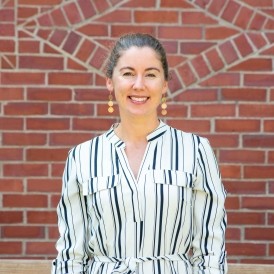
Alice Johnston
BA (Dalhousie), M.Ed. (University of Saskatchewan), PhD (Queen’s University) Assistant Professor of Assessment and Curriculum Theory
Alice Johnston (she/her) is a settler scholar and an Assistant Professor in the Faculty of Education at St. Francis Xavier University. She completed her PhD in Curriculum Studies at Queen’s University, where her doctoral research identified principles for decolonizing STEAM+ learning materials and examined how this work shapes both communities and institutions.
Before moving into academia, Dr. Johnston spent nearly a decade working in P–12 schools serving primarily First Nations and Métis students. These experiences continue to inform her work in teacher education, particularly her commitment to supporting teachers in engaging thoughtfully and responsibly with Indigenous ways of knowing, being, and relating to the natural world.
At St. FX, Dr. Johnston teaches undergraduate courses in classroom assessment and environmental education, as well as graduate courses in curriculum studies and research methods.
Dr. Johnston’s research brings together several interconnected areas of curriculum and education, including climate justice education, decolonizing classroom assessment, and Land-based learning in STEAM+ education.
She is Principal Investigator on the SSHRC Insight Development Grant, Decolonizing Classroom Assessment: Co-Developing and Piloting a Locally Grounded Mi’kmaq Assessment Framework. Working with Mi’kmaw teachers and community partners, the project focuses on developing and piloting a locally grounded Mi’kmaq classroom assessment framework and related teacher-facing tools. The project asks how classroom assessment can better reflect Mi’kmaq ways of knowing, being, and doing while supporting more holistic approaches to understanding student learning.
Dr. Johnston is also a co-applicant on the SSHRC Insight Grant, Anti-colonial Land-Based Climate Justice Pedagogies for Canadian Secondary Classrooms: Education for Repair, Healing, Joy, and “Relational Renewal.” This national project brings together educators and youth in Ontario, Nova Scotia, and Saskatchewan to explore Land-based and anti-oppressive approaches to climate justice education. Dr. Johnston co-leads the northern Nova Scotia site, where educators and youth are working together to develop teaching approaches and resources grounded in their local context.
She is additionally co-applicant on a second SSHRC Insight Grant, Climate Justice Education in Ontario: Creating and Sustaining a Professional Learning Community. This project focuses specifically on professional learning for climate justice education and explores the pedagogies, activities, and resources that support sustained teacher engagement in this important work. [Read more about the preliminary research informing this SSHRC-funded project here.]
From 2020 to 2023, Dr. Johnston served as Project Coordinator for the Queen’s University Indigenous Land-Based Learning STEM (QUILLS) Program, supported by an NSERC PromoScience grant. Working in partnership with Anishinaabe and Haudenosaunee community members from the Katarokwi (Kingston) region, the initiative produced five classroom-ready Learning Bundles that centre Indigenous Land-based knowledge, incorporate local scientific studies, and align with Ontario curriculum expectations.
Research Interests
- Climate justice education
- Decolonizing classroom assessment
- Land-based learning
- STEAM+ education
- Outdoor and environmental education
- Curriculum theory
SELECTED PUBLICATIONS
Johnston, A. (forthcoming). Disrupting colonial separability: Indigenous ontologies and relational STEAM+ learning. In C. Karsgaard & P. Howard (Eds.), Bridging social and ecological justice in education. EWSP Press.
Johnston, A., & Sylliboy, S. (forthcoming). A decolonial look at outdoor education today. In A. Foran, K. Redmond, & S. Dwyer (Eds.), Quality lesson plans for outdoor education (2nd ed.). Human Kinetics.
Gyamerah, K., Mao, J., Johnston, A., Hodges, E., Pillay, T., Pashby, K., & Butler, A. (2025). Decolonial STEM education and the integration of a critical global citizenship education framework in an Ontario secondary school. Comparative and International Education, 54(1), 15–31. https://doi.org/10.5206/cie-eci.v54i1.19989
Johnston, A. (2022). Taking learning outside. In K. Riley, J. McVittie, & M. G. Boles (Eds.), Decolonizing environmental education for different contexts and nations (pp. 97–116). Peter Lang.
Johnston, A., & Claypool, T. (2010). Incorporating a multi-method assessment model in schools serving First Nations, Inuit, and Métis learners. Native Studies Review, 19(2), 121–138.
OTHER CONTRIBUTIONS
Johnston, A. (2024, June 22). Land-based learning in the Limestone District School Board. Skeleton Park Press, 16(9), 9. https://skeletonparkartsfest.ca/wp-content/uploads/2024/06/SP_v16_FORWEB_4Jun2024.pdf
Elbow Lake Environmental Education Centre. (2022, September). Accessible trail interpretive signs [Multilingual interpretive signage and trail app stations reflecting Anishinaabe and Kanyen’kehá cultural heritage at the Elbow Lake Environmental Education Centre]. 1500 Hewlett-Packard Lane, Perth Road, ON K0H 2L0. https://qubs.ca/news/2022/10/01/new-indigenous-interpretative-signs-elbow [Project Manager]
Elbow Lake Environmental Education Centre. (n.d.). Queen’s University Indigenous Land-Based Learning STEM (QUILLS) Program. https://elbowlakecentre.ca/quills/ [Program Developer and Coordinator]
Johnston, A. & Davies, J. (2019). Understanding and mobilizing the inquiry into missing and murdered Indigenous women and girls calls to justice. The Knowledge Forum, 1(2), 23-25. https://educ.queensu.ca/sites/educwww/files/uploaded_files/Research/Knowledge%20Forum/KnowledgeForum2019.pdf