

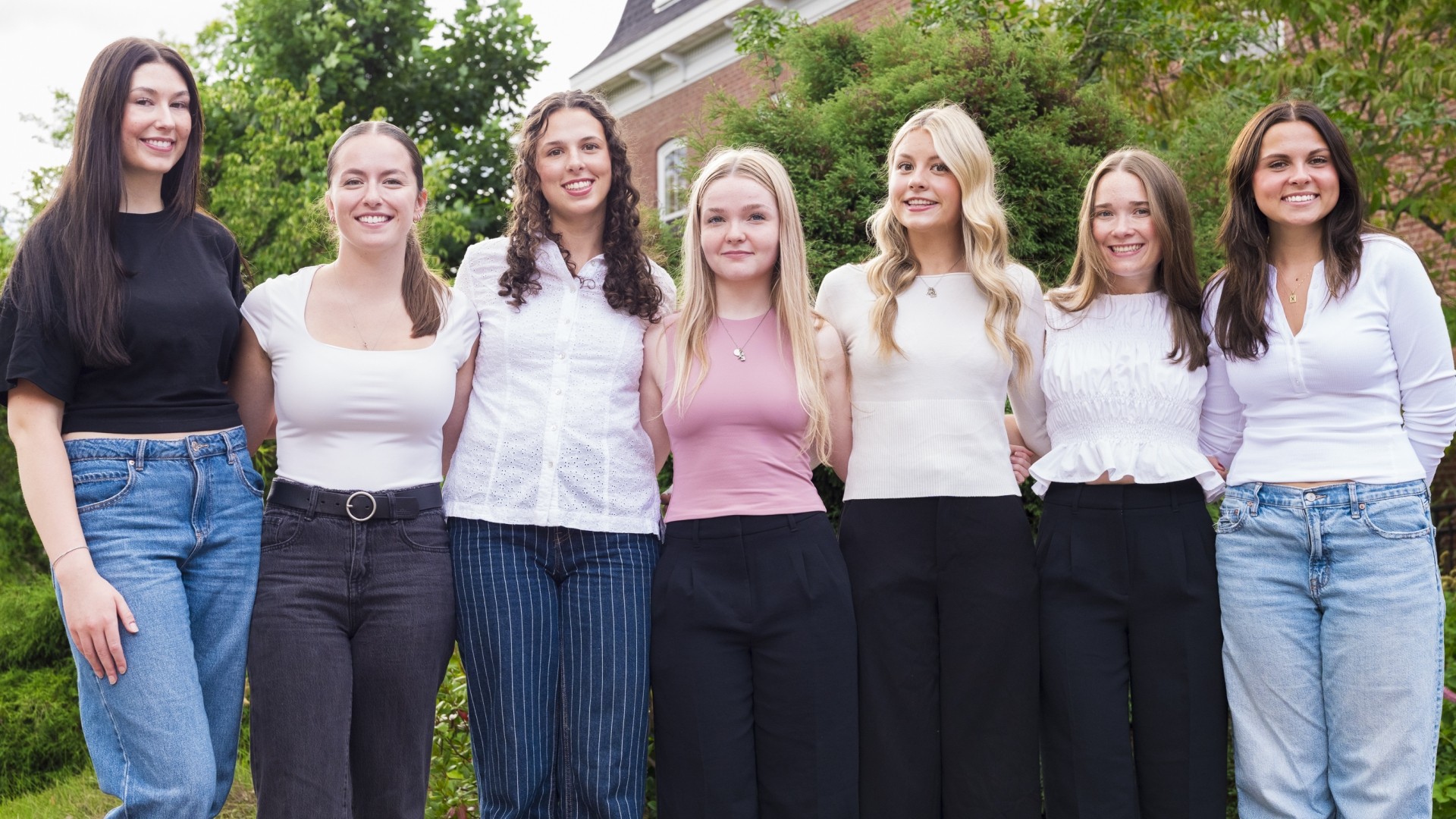
When StFX student Kate Harding was diagnosed with endometriosis, she couldn't find research that reflected her experience. This year, funded by the Walker Wood Foundation Research Grant, she had opportunity to immerse herself in that research topic as one of seven StFX students funded by this award.
The students, Brenna Alford, Jaylene Nauss, Peyton Sampson, Josey Forbes, Anna Stewart, Lorelei Morris, and Ms. Harding, each received $9,250 as award recipients and spent the summer working on original health-related research projects, from genetic clues in colorectal cancer to gaps in pediatric pain care. The students all worked under the supervision of a StFX faculty member.
INCREDIBLE EXPERIENCE
“Having the opportunity to conduct the research I wished existed growing up and contributing to the field of women’s health was an incredible experience that I would not have had without this summer research award,” says Ms. Harding of Lethbridge, AB, a fourth year BASc in Health student taking a concentration in biomedical science.
Working under the supervision of Dr. Kara Thompson, Director of the Victor and Mona Dahdaleh Institute for Innovation in Health, and Research Chair in Substance Use Policy and Prevention at StFX, she is exploring women’s health and experiences with endometriosis. Ms. Harding says she learned more about the existing literature, where gaps persisted in endometriosis research, and how she can contribute to the field and improve experiences for others living with the condition.
Endometriosis, she says, is a chronic, incurable inflammatory disease affecting an estimated 10–15 per cent of women of reproductive age, though this is likely underestimated due to diagnostic delays, misdiagnosis, stigma, and limited research. Despite being among the most painful conditions globally, its pathology and etiology remain poorly understood, she notes. Because there is no cure, individuals must rely on various treatments, symptom-management strategies, and coping mechanisms.
She found university students to be an underrepresented demographic in this area of research, so she wanted to explore health-related quality of life from their perspectives and understand how endometriosis affects their everyday lives. Ultimately, she hopes these reflections of lived experience could help inform and support individuals with endometriosis, healthcare providers, and even be implemented into healthcare and academic settings.
ROLE GENETICS PLAYS IN DISEASE DEVELOPMENT
Brenna Alford of Red Deer, AB, a fourth year honours biology student mapped the genetic pathways linking chronic gut inflammation, inflammatory bowel disease (IBD), and colorectal cancer (CRC), focusing on gene variants involved in the inflammatory processes. Using statistical analysis in R, she aimed to determine whether these genetic variants are associated with an increased risk of developing CRC.
“My interest in this research topic was mostly sparked by my interest in human health and disease, and the role genetics plays in potential disease development. When I first met (supervisor) Dr. Derrick Lee as a second year student taking his statistics class, he mentioned his research, and I was immediately eager to learn more about how genetic factors can contribute to diseases such as colorectal cancer.
“One of the most interesting things was seeing how complex the relationship between genetics, inflammation and disease can be,” she says.
Ms. Alford says this research experience taught her a lot about herself, not only as a student but also as a person. She became more confident working independently and was able to develop new skills in coding and data analysis. “This taught me how to work through challenges when things did not go as expected. I have always dreamed of entering the medical field, and this research allowed me to contribute to identifying possible genetic risk factors that may eventually support preventative efforts for colorectal cancer and how genetic factors can make a meaningful difference in patient care. I am so grateful for all the support I have received from Dr. Lee and the opportunity to work under him.”
MAKING A DIFFERENCE IN SOMETHING BIGGER THAN OURSELVES
“The Walker Wood Foundation Research Grant has allowed me to prioritize my research while also helping to develop my skills as a student researcher and future nurse. Opportunities such as this are invaluable to students, as they allow us to focus on our research and to contribute to making a difference in something bigger than ourselves,” says Peyton Sampson of Porters Lake, NS.
The fourth year nursing student is completing an honours research project, supervised by Dr. Britney Benoit. She is examining existing pediatric pain care practices across Nova Scotia.
This research involves a non-interventional, cross-sectional survey designed to explore current practices within pediatric healthcare settings. These findings will be compared with the National Pediatric Pain Management Standard to identify existing strengths, gaps, and opportunities for improvement in pediatric pain care.
“My interest in this area of research stems from my passion of pursuing a career in pediatric nursing and my belief in the importance of advocating for improved pediatric pain care. Through this experience, I have developed a deeper understanding of the importance of nursing research to help identify the gaps in healthcare delivery,” Ms. Sampson says.
OPEN ANOTHER SIDE OF ACADEMIA
Opportunities like this research award are important as they open a whole new side of academia to students, says Josey Forbes, a third year psychology student from Tatamagouche, NS. She spent her summer researching the repeatability of cerebrovascular reactivity measurements obtained using Functional Near-Infrared Spectroscopy (fNIRS). Dr. Erin Mazerolle is her supervisor.
“It has been a huge privilege for me to be able to get up every day and do something that I love and am proud of without jeopardizing my financial stability,” says Ms. Forbes.
fNIRS is a neuroimaging device that has great potential to help with research and long-term monitoring of various vascular conditions in the brain, she explains.
“Before it can be used in those contexts, we need to be sure that the measurements it produces are consistent and reliable. We have been evaluating this by inviting healthy adults to complete two fNIRS sessions, one week apart. If the measurements are repeatable, they should look similar between sessions. The project is ongoing, but things are looking good so far.”
Ms. Forbes says this work is particularly important to her because she is from a rural community where traditional neuroimaging technology is not available.
She says one thing she really enjoyed is being part of a collaborative team. She has helped other summer students with their projects/events and received help and feedback in return. “The support that I have received from Dr. Mazerolle and the members of the lab is invaluable.”
MAJOR IMPACT ON ACADEMIC AND CAREER DIRECTION
Lorelei Morris of Halifax, NS, a third year human kinetics student taking a minor in health sciences, focused her research on designing a full study examining whether wearable muscle near-infrared spectroscopy (mNIRS) sensors can personalize treadmill training for adults aged 40-59.
The goal was to understand whether real-time muscle oxygenation signals could help guide interval training in a way that improves adherence, safety and physiological outcomes, especially for adults who benefit from time-efficient exercise.
“This experience has had a major impact on my academic and career direction. It strengthened my interest in physiology while building confidence in designing independent research projects. It improved my technical and data analysis skills, while reinforcing my long-term interest in medicine and showing me how applied physiology can support healthier living for adults. It was the first time I built a study from scratch, and that independence changed how I feel about my own skills and experiences gained,” she says.
Her supervisor was Dr. Daniel Kane, whose work focuses on exercise physiology, metabolism and sensor-based monitoring. “His mentorship shaped both the scientific direction of my research project and also my development as an independent researcher.”
RELATIONSHIP BETWEEN OBESITY AND COLORECTAL CANCER
Jaylene Nauss of Bridgewater, NS, a fourth year honours biology student taking a minor in chemistry, worked this summer with Dr. Derrick Lee to examine the relationship between obesity, obesity-related genes, and colorectal cancer (CRC). Specifically, she was interested in understanding how genetic factors associated with obesity may influence an individual’s risk of developing colorectal cancer.
“My desire to investigate this topic stemmed from my interest in cancer biology and genetics, as well as my passion for cancer research. Colorectal cancer is the fourth most common cancer in Canada, as well as the third leading cause of cancer-related deaths. Atlantic Canada is disproportionately affected by this disease, for reasons not fully understood. Due to this, I was interested in exploring how certain genes and environmental risk factors could influence cancer risk in Atlantic Canada.”
Ms. Nauss, who is interested in a career in the healthcare field, says this research experience helped her grow academically and personally.
“Research does not always provide immediate or straightforward answers, and I learned the importance of being patient, asking questions, and being willing to learn from unexpected results. Overall, the experience strengthened my interest in biology and healthcare and helped me see how research is essential to improve our understanding of human health,” she says. “For me, this experience has been an important step toward my career in the healthcare field. I am incredibly grateful for the Walker Wood Foundation’s contribution towards my research project, and for all the opportunities it provided me with.”