

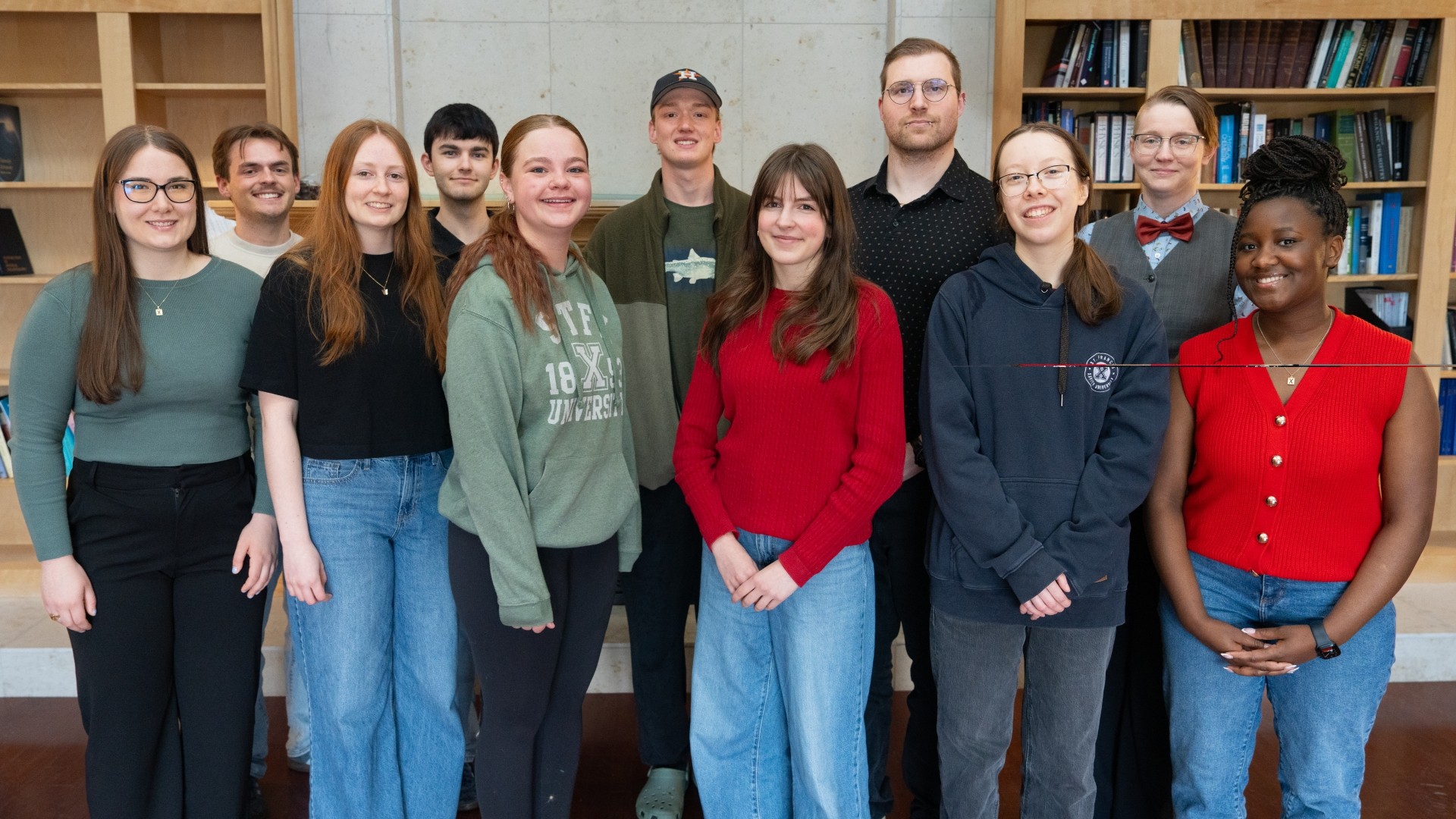
From studying peanut allergens to finding patterns in how bullfrogs interact when calling, 16 StFX students conducted hands-on research this summer, gaining both skills and confidence, as recipients of the Natural Sciences and Engineering Research Council of Canada (NSERC) Undergraduate Student Research Award (USRA).
The NSERC-USRA provides each recipient with $9,250 in funding. Research projects ranged from testing alternative gravity theories to modelling opioid overdose trends, tracking juvenile lobster behaviour on the ocean floor to studying how mangrove fish adapt to life on land. Each student participated in a summer of independent research, mentored by a StFX faculty member.
This year’s recipients are Amaya Giraudier, Adalia Wambolt, Emillie Murdock, Madelyn Shaw, Kiersten MacGrath, Chipo Chitate, Spencer Bussieres, Carter Clifton, Liam Kirkham, Chris Richard, Kate Redfern, Molly Asseltine, Natalie Dawson, Jaime Burns, Brooke MacDonald, and Lauren Pictou.
APPLYING CLASSROOM SKILLS TO SCIENTIFIC QUESTIONS
“Research opportunities like NSERC give undergraduate students the chance to apply what we learn in class to real scientific questions. Having an entire summer to focus on research allows you to develop skills, become more independent, and experience what the research process is actually like. It can also introduce you to areas of science you may never have considered before,” says fourth year honours biology student Emillie Murdock of Merigomish, NS.
“For me, being able to get involved in research so early in my degree has shaped a large part of my StFX experience and has opened doors that I never expected when I started university.”
Working under the supervision of Dr. Jen Perry, her research focuses on cold tolerance in water striders. These insects experience very cold temperatures in the Canadian Maritimes, so she’s interested in understanding how they can survive these conditions and why cold tolerance can differ between species.
Ms. Murdock has worked with Dr. Perry since her first year and credits her as a huge part of her development as a researcher. She says the lab environment is collaborative, even though everyone is working on different projects, and that it’s been inspiring to work alongside master students and PHD researchers.
UNDERSTANDING THE SCIENCE BEHIND ALLERGIC REACTIONS
Chipo Chitate, a third year chemistry student from Pictou County, supervised by Dr. Alex Foo, spent her summer assessing the impact of peanut allergens on lipid membranes.
“We investigated whether Ara h 2, a major peanut allergen, and peanut extracts could disrupt lipid membranes. We questioned whether this could potentially contribute to allergic responses. Our results suggested that membrane disruption is likely not a key mechanism behind peanut allergenicity.”
Her interest in the subject was sparked by her own experience with a peanut allergy, and a fascination as to why her body reacts differently to peanuts compared with others. “Having a personal connection to the topic made me especially interested in understanding the science behind allergic reactions and the mechanisms that contribute to them.”
She says the most surprising part was finding that the peanut allergen they studied did not significantly disrupt lipid membranes. “While these could be considered ‘negative’ results, they were still valuable because they helped challenge an existing idea and pointed toward other mechanisms that may explain peanut allergenicity.”
Ms. Chitate says research opportunities give students the chance to apply what they learn in the classroom to real scientific questions, build confidence, develop skills, and discover areas of science they may want to pursue.
“As a Black woman in STEM, I believe opportunities like this are especially important for students from underrepresented backgrounds in STEM because they provide the chance to see themselves as scientists and researchers. Having hands-on research experience has helped me build confidence in my abilities and recognize that there is a place for everyone in scientific research. These experiences can help make STEM feel more accessible and encourage more diverse perspectives.”
A POSITIVE IMPACT ON ACADEMIC TRAJECTORY
Spencer Bussieres of Orillia, ON is a fourth year human kinetics student completing an honours Bachelor of Science with a major in kinesiology and a minor in biology. His research looked at a process known as joint action, or how non-verbal cues, such as facial expressions and body language, affect how people coordinate movement and interact with each other.
Working with supervisor Dr. Melanie Lam, he examined how emotional expressions influence a person’s decision and willingness to perform a coordinated movement, such as handing an object to a partner, to better understand the underlying processes that drive everyday human coordination. He says understanding how emotion shapes physical coordination can help inform the development of social robots designed to interact and aid older adults.
Mr. Bussieres's interest in motor control took root in Dr. Lam's second year introduction to motor control and learning course and deepened in Dr. Lam's fourth year class on control of human movement.
“Coming into the summer unsure of my postgraduate plans, I found that conducting hands-on research provided the clarity and fulfilment I needed, solidifying my decision to pursue a master’s degree in the field,” he says.
“This growth has been my most impactful takeaway, giving me the momentum and confidence I need to jump headfirst into my honours thesis project this fall. To top it all off, this summer has opened doors I never anticipated—from presenting findings at an upcoming conference in Ottawa to working towards co-authoring a manuscript.”
GUIDING STUDENTS TOWARD THEIR FUTURE
Summer research is important for students as it allows them the opportunity to keep learning, and continue doing what interests them, while getting paid. It’s also a good experience for someone planning on pursing further education, “and it can guide you towards what that future education might look like,” says Madelyn Shaw.
Ms. Shaw, who is from Dunster, BC, is a third year student working towards a joint honours Bachelor of Science degree in physics and math as well as a Diploma in Engineering.
Working with supervisor Dr. Robert van den Hoogen, she conducted research on alternative gravity theories. They were trying to understand the feasibility of using different underlying geometries within these theories.
“This research interested me because I was wanting the opportunity to do more mathematics, and doing this research required knowledge in areas of mathematics that I wouldn't have seen at StFX otherwise,” she says. “This experience further confirmed to me how much I love mathematics. I really enjoyed the research I did this summer, and this experience will definitely help guide me to where I want to go after my undergraduate degree at StFX.”
APPLYING MATHEMATICS TO REAL WORLD SETTING
Natalie Dawson of Moncton, NB, a fourth year Bachelor of Science in mathematics and a Diploma in Engineering student, spent her summer researching bullfrog choruses by analyzing raw audio recordings to better understand their collective calling behaviour. Using MATLAB, she developed code to process the recordings and extract the timing of individual frog calls. She identified features including the average time between calls, the number of calls in a sequence, the duration of a sequence and the call density. She used these measurements to determine if a given sequence was a single frog or multiple frogs. She was interested in using the collected data to find patterns in how bullfrogs interact when calling alone and when they are calling with other frogs.
Ms. Dawson, who is supervised by Dr. Ryan Lukeman, says the experience had a significant impact because it taught her how to problem-solve and adapt when things did not go as expected. “While extracting frog calls from raw audio recordings, I came across a variety of background noises, including wind, airplanes, and other animals, which made the process more challenging. Learning how to work through these obstacles helped me build confidence in my research and analytical skills.”
The experience also strengthened her interest in applied mathematics. “Since my first year at StFX, I have been inspired by Dr. Ryan Lukeman's work and the way he demonstrates how mathematics can be applied to real-world problems. Through this research, I was able to experience this myself by extracting meaningful numerical data from raw audio recordings and using it to study bullfrog behaviour.”
UNDERSTANDING LOBSTER BEHAVIOUR IN THE FALL
Liam Kirkham, a fourth year student from Ottawa, ON, focused his research on learning about juvenile lobster behaviour using remote underwater video. He wanted to better understand how lobsters behave in the field since most lobster research has been done in the lab. “I am mainly looking at how juvenile lobster shelter and how it changes temporally over days and months as ocean conditions change. I am also looking at what factors influence the outcomes of lobster interactions with other lobsters and other species.”
His interest was sparked after his first year of research when he used baited remote underwater video to study juvenile lobster density across the Gulf of St. Lawrence and between different substrates. “We also looked at their behaviour and how it changes with these factors. After I finished with this project I wanted to see how lobsters behaved without the presence of bait and with little to no outside factors that would influence them.”
Mr. Kirkham, who is supervised by Dr. Russell Wyeth, says it was also cool during his research to see other species pass through the cameras, including an American eel, which are endangered in the Ottawa River where he lives.
“This experience has taught me the fundamentals of research and field biology and has set me up well to continue pursuing research for my masters,” he says.
TACKLING ENVIRONMENTAL POLLUTANTS
Adalia Wambolt of Middle Sackville, NS, a fourth year chemistry student, says her research aims to develop a system to break down hydrophobic pollutants in aqueous environments. “We are trying to use viologens in mixed micelles to act as redox shuttles to degrade these pollutants,” she explains.
“Pollutants in the environment are a very widespread issue. The opportunity to work on a project that aims to address this was very interesting to me.”
Ms. Wambolt is supervised by Dr. Alex Foo and says she received help from other department faculty including Dr. Brian MacLean, Dr. Gerrard Marangoni and Dr. Geniece Hallett-Tapley. She says it’s been interesting to learn many new techniques across multiple fields of chemistry for this project. The project also took unexpected turns, but she notes they gained a lot of intriguing data that’s she excited to dig into in her honour’s thesis.
She also credited the experience with making her more capable of multitasking and keeping multiple ideas in mind when problem solving. And it allowed her to attend the ChemCon conference and present her research.
BUILDING ON HONOURS THESIS
Brooke MacDonald of Antigonish, NS graduated in May 2026 with an honours degree in human kinetics. Her work this summer, supervised by Dr. Tammy Rodela and Dr. Daniel Kane, continued research she began during her honours thesis on the mangrove rivulus, “a remarkable amphibious fish that can leave the water and survive on land when water conditions are unfavourable.
“Mangrove rivulus are also unusual because they are hermaphroditic and can produce genetically identical offspring, and males occur at low frequencies in both natural and laboratory populations. But because males are relatively rare, we still know very little about whether they respond differently to hermaphrodites when adjusting to life on land, particularly at the mitochondrial level.”
She examined how conditioning through repeated exercise on land affected jumping behaviour, mitochondrial activity, and mitochondrial content in hermaphrodites and males. Through this work, they hoped to get a better understanding how biological sex influences how these fish adjust to and perform on land.
The opportunity to engage in a second summer of research has been incredibly rewarding, she says.
LEARNING ABOUT FREEZE TOLERANCE
Kiersten MacGrath of Antigonish, NS completed three years of study at StFX and entered the PharmD program in September. Over the summer she worked with Gryllus veletis (also known as the spring field cricket). “My main research project was working on determining the effect of supervillin knockdown using RNA interference on the actin cytoskeleton and freeze tolerance of G. veletis. Supervillin is a protein found in their tissues associated with the actin cytoskeleton of cells, and lessening its presence was hypothesized to decrease actin accumulation which would result in a lower survival rate following freezing. G. veletis are a freeze-tolerant species, meaning they can survive freezing in their tissues after a period of acclimation.”
She became interested in the topic after volunteering during her third year for Dr. Jantina Toxopeus, who became her research supervisor.
“This experience has impacted me very positively. Learning more about research as a career path definitely sparked interest in me pursuing this option further down the line. I hope to learn more about the world of pharmaceutical research when completing my pharmacy degree,” she says.
APPLYING MATH TO A PUBLIC HEALTH CRISIS
Carter Clifton is from Antigonish, NS and is a fourth year honours math student. He worked under the supervision of Dr. Ryan Lukeman.
“My research project was about using a mathematical model to predict the number of opioid-related overdoses and fatalities based on a number of factors related to the drug users, as well as the drug supply as a whole.” They looked at different things known to have changed during the COVID-19 pandemic and implemented them into their model to see the change in opioid mortality.
Mr. Clifton’s says his interest in this work began with the large increase in opioid related fatalities that occurred at the beginning of the pandemic. “I wanted to try and figure out why the increase happened, and what policy decisions could possibly be made to lower the number of fatalities back down to, and past, the pre-pandemic levels. Overall, I think it is important to support vulnerable populations, and this work can help do that.”
They found that the number of additional overdoses their model predicts based on factors directly related to the pandemic did not account for the observed increase in opioid mortality. “Instead, we believe the additional fatalities came from a simultaneous increase in the amount and makeup of fentanyl in the illicit drug supply.”
Mr. Clifton says the experience strengthened his love for mathematics and has made him even more sure he wants to pursue post-graduate studies.
INCOMPARABLE EXPERIENCE
“Digging into something independently and learning to navigate it in a way that aligns both with standard research practices and your own work style is an incomparable experience,” says Kate Redfern, an honours computer science student who’s originally from Edmonton, AB, but now lives in Boylston, NS. “Add in the fact that you’re immersed in it full time for a whole summer, and you just learn it to a deeper level than from a class. It’s the closest you can get to industry experience.”
Ms. Redfern, who is supervised by Dr. Erin Mazerolle, worked on a software development project, applying computational methods to address the reproducibility crisis in neuroimaging research, specifically fMRI data analysis. Her goal was to add a feature to the software to automate the selection of analysis parameter ranges for fMRI datasets and create accessible documentation of the software for prospective users.
“I’m very interested in the study of neurodegenerative disease and acquired cognitive decline, and neuroimaging has the potential for use as a noninvasive tool to assist in research into these conditions; potentially even their identification and diagnosis,” she says.
The most surprising thing she learned was the software didn’t run. “Sometimes if software goes unmaintained for long enough, problems can arise because the rest of the world keeps moving forward and things become out of date very quickly. While a summer of debugging was more frustrating than I anticipated, I have learned so much about fMRI neuroimaging, using high performance computing clusters and job schedulers, data management, and working as part of a development team.”