


MSc biology student Mélina Chicoine is exploring how natural enemies could help stop a tiny weevil that is killing Nova Scotia’s American beech trees.
A tiny weevil is killing Nova Scotia’s American beech trees and Mélina Chicoine, an MSc biology student at StFX, wants to know how natural enemies and the role of winter survival could help stop this.
Ms. Chicoine, who is supervised by Dr. Jen Perry and Dr. Jantina Toxopeus, has been awarded a $3,500 Frances Elizabeth Hilder Scholarship in forest conservation from the Canadian Wildlife Federation.
Her research focuses on the beech leaf-mining weevil (Orchestes fagi), a forest pest attacking Nova Scotia’s beech trees (Fagus grandifolia), and on ways to use the insect’s natural enemies to limit its populations. Temperature represents a second potential constraint she’s investigating.
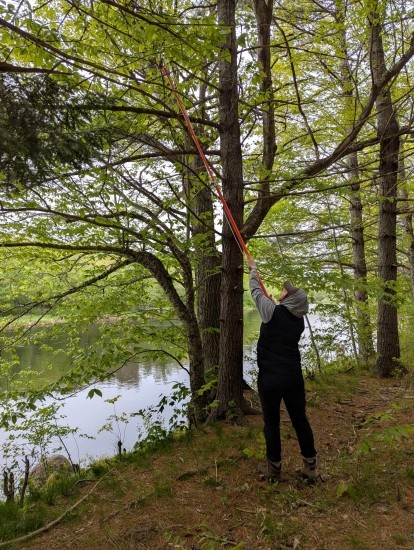
Ms. Chicoine says she was happy and surprised to receive this Canada-wide scholarship. “It felt like my research and hard work were valued,” she notes.
A TINY INSECT WITH A BIG IMPACT
Originally from Europe, the beech leaf-mining weevil is now found throughout Nova Scotia and has spread to Prince Edward Island and New Brunswick, she says. It was first confirmed in Halifax, NS in 2012, though some believe it may have arrived as early as 2006.
The weevil is difficult to detect, measuring only about two millimetres. For eight to nine months of its life cycle, it lies dormant, hidden in the bark of the tree. That means cutting down an infested tree and moving it can easily spread the insect, she explains.
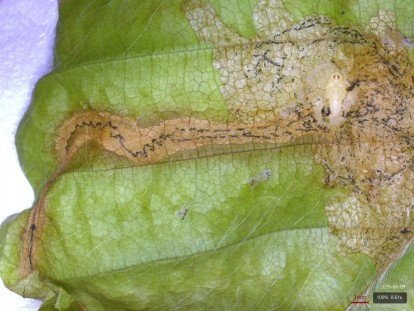
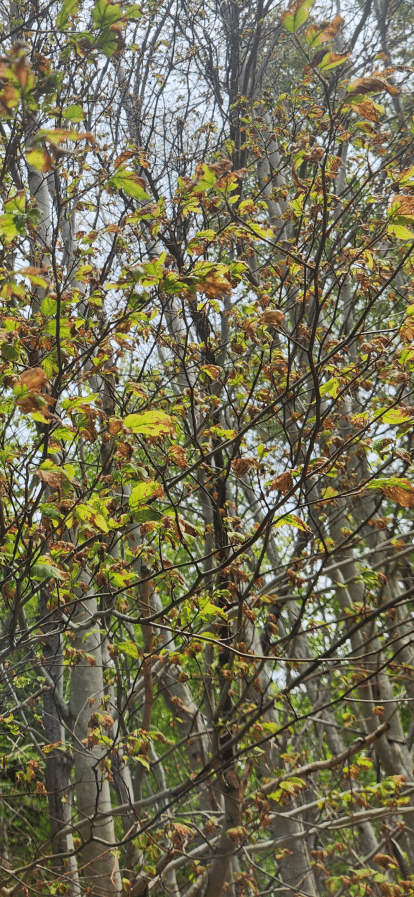
When beech buds emerge and the leaves begin to open in spring, the adults wake up to feed and reproduce. Their feeding creates small holes in the leaves and causes necrosis, which can reduce the photosynthetic capacity of the tree. Ms. Chicoine says research shows that within five to seven years of consecutive damage, 90 per cent of mature trees can die.
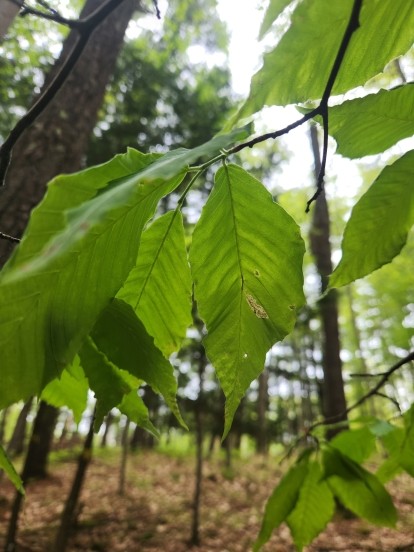
“We need to act right now,” she says, noting these outcomes are important for forestry and the conservation of Acadian forests, where American beech play an important ecological role, notably as a food source for wildlife.
Insecticide treatments have shown lower effectiveness and do not affect adults, which are responsible for a large portion of the damage.
Ms. Chicoine’s research explores biological control, which uses another insect or organism found in nature to limit a pest’s spread.
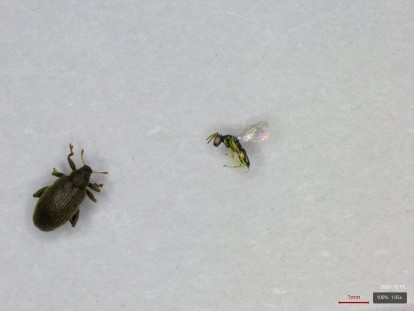
She is studying parasitoids, a type of wasp that kills its host. The wasp lays its eggs inside or on the weevil’s larvae, and the parasitoid larvae then develop by feeding on the weevil.
Over the summer, she collected beech leaves from across Nova Scotia showing signs of O. fagi larval galleries. She then monitored the leaves to determine what emerged: a parasitoid wasp or a weevil.
By tracking the number and proportion of parasitoids and weevils that emerged, she can estimate parasitism rates and assess the potential of these parasitoids as biological control agents.
She is also investigating whether cold limits the weevil’s expansion.
Her project addresses this knowledge gap by determining the weevil’s cold tolerance strategy and survival limits.
Ms. Chicoine is from Granby, Québec, and arrived in Antigonish in May after completing an undergraduate degree in ecology at Sherbrooke University.
She has been collecting data throughout the summer and will continue her field collections in summer 2027.
She says she has been fascinated by insects since childhood, drawn to their beauty and diversity. She completed a number of internships, including three in entomology during her undergraduate studies. A summer 2025 internship at CABI in Switzerland, where she worked on biological control using wasps, confirmed her passion for the field.
“The trees are dying and we should protect them,” she says. “It’s a subject that needs more research.”