

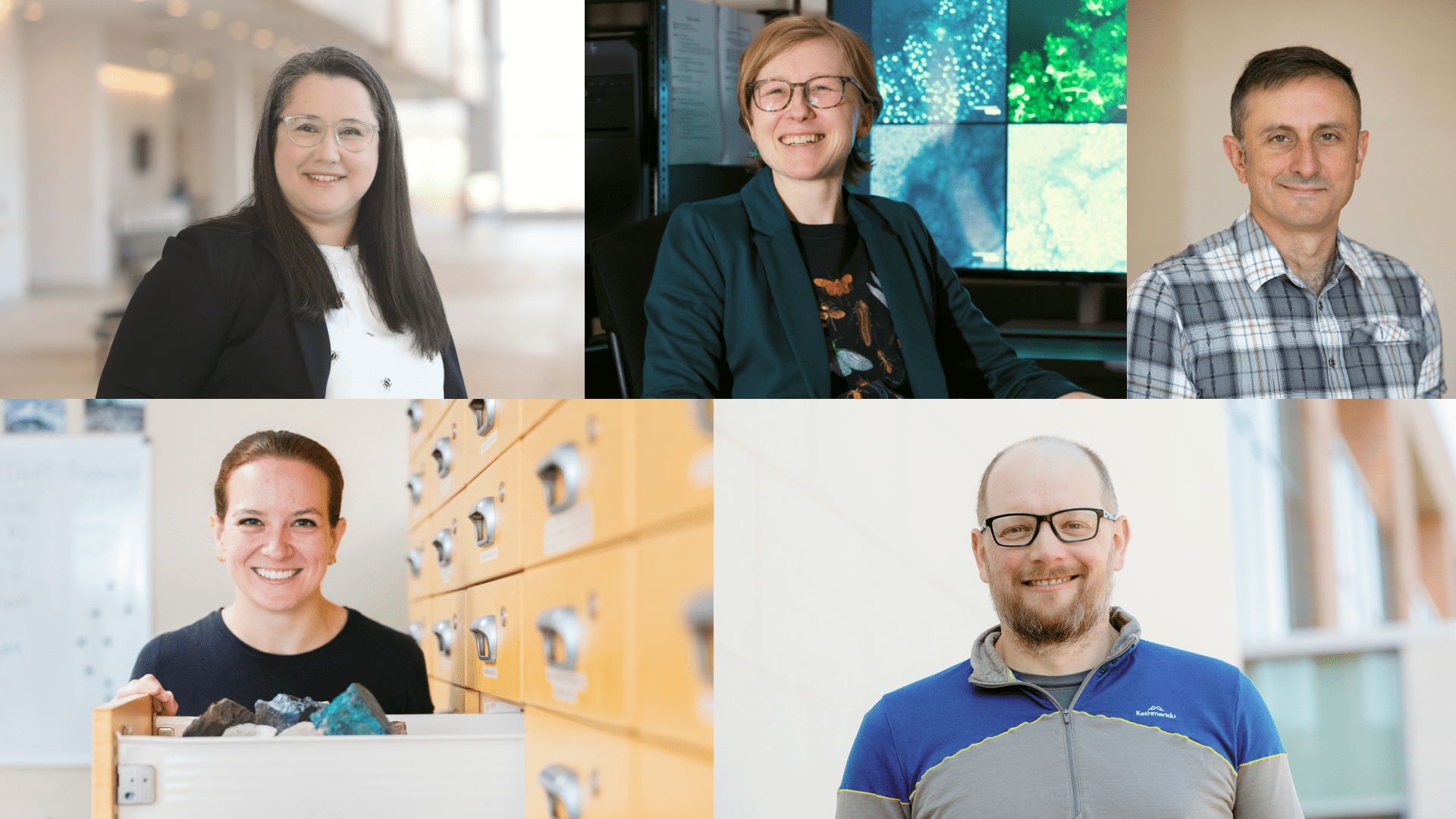
Research with applications in forestry, agriculture, aquaculture, and critical mineral exploration has received a significant investment as two teams of St. Francis Xavier University researchers have been awarded nearly $300,000 through the John R. Evans Leaders Fund (JELF), funded through the Canada Foundation for Innovation (CFI).
Dr. Jantina Toxopeus, Dr. Cory Bishop, and Dr. Tammy Rodela in the StFX Biology Department have received $75,000 in JELF funding for renewal of molecular biology and biochemistry equipment (including a microcentrifuge, a microplate spectrophotometer, and a thermal cycler) to support research programs that will provide information that improves management of forestry, agriculture, and aquaculture. These projects include characterizing the overwintering biology of eastern spruce budworm, a key pest of the boreal forests; understanding the fundamental biology and evolution of a unique symbiosis between eggs of amphibians and single-celled algae; determining how frass (a waste product) from rearing black soldier flies improves the growth of plants; and measuring stress in cultivated oysters during cleaning treatments that are important for their growth and marketability.
Dr. Donnelly Archibald and Dr. Celeste Cunningham in the Department of Earth and Environmental Sciences have received $223,875 in JELF funding for high-resolution imaging infrastructure needed to support research aimed at understanding the natural concentration and formation of critical minerals. A Scanning Electron Microscope (SEM) will be used primarily to examine rock and mineral samples. Dr. Cunningham and Dr. Archibald, both early career researchers with international expertise in SEM applications, will investigate the relationships between magmatism, tectonics, critical mineral endowments, sedimentology, paleoclimate, and Earth’s evolution. The new infrastructure will help strengthen Canada’s capacity to research secure and reliable supplies of critical metals.
“This is an outstanding achievement. These critical investments in the latest scientific equipment will allow our researchers to conduct innovative and cutting edge research that will have an impact on the mining and forestry sectors here in Nova Scotia,” says Dr. Erin Morton, StFX Associate VP Research, Graduate and Professional Studies. “Congratulations to all five researchers and their teams on this significant investment. This research is timely, innovative, and will make meaningful impacts.”
More information on each researcher follows:
Dr. Jantina Toxopeus studies the overwintering physiology and diapause of insects, primarily using cell and molecular biology, and biochemical techniques. This includes investigation of the freeze tolerance mechanisms in a model organism (spring field crickets), and cold tolerance of pests such as black-legged ticks (vectors of Lyme disease) and spruce budworm (forest pest).
Dr. Cory Bishop researches the evolutionary origin and function of a symbiosis between unicellular green algae and egg masses of several amphibians. This symbiosis occurs in four frog and two salamander species distributed in North America, Japan and Europe, and in one case involves the only known instance of an endosymbiotic relationship between a photosynthetic eukaryote and a vertebrate. More recently, Dr. Bishop has developed an applied research program concerning the use of frass, a waste product from industrial insect production, as soil bio-amendment, with the goal of reducing the carbon emissions profile of Canada’s agricultural sector.
Dr. Tammy Rodela’s research program characterizes the physiological stress responses of aquatic animals under multiple, interacting environmental stressors. By integrating various animal models, including oysters, mussels, zebrafish and mangrove rivulus fish, this research bridges ecosystem-scale challenges with mechanistic insights from model organisms. This contributes to fundamental knowledge of phenotypic plasticity and stress physiology, while also informing sustainable aquaculture, enhancing biodiversity conservation, and improving predictions of species resilience in the face of rapid environmental change.
Dr. Donnelly Archibald is an expert in granite petrogenesis, petrochronology and he maintains strong research collaborations with other academic institutions and industry partners. Dr. Archibald’s research involves investigating Earth processes and how material moves and differentiates in Earth’s crust. His research employs U-Pb geochronology, whole rock geochemistry, and isotopic analyses to investigate ancient tectonic environments with an emphasis on granite petrology, their contained mineral resources including critical metals, and the use of igneous rocks as probes of tectonic evolution of mountain belts.
Dr. Celeste Cunningham explores the Earth’s surface environments and the relationships between geological processes, the evolution of complex life, and climate during pivotal intervals in Earth’s history by studying the ancient sedimentary rock record. This record provides an archive of long-term climatic trends, sea level fluctuations, tectonic cycles, biogeochemical cycling processes, carbon capture and burial, glaciations, and the evolution of life. Dr. Cunningham’s research uses sedimentary petrology, microbeam analytical techniques, and geochemical analysis.