

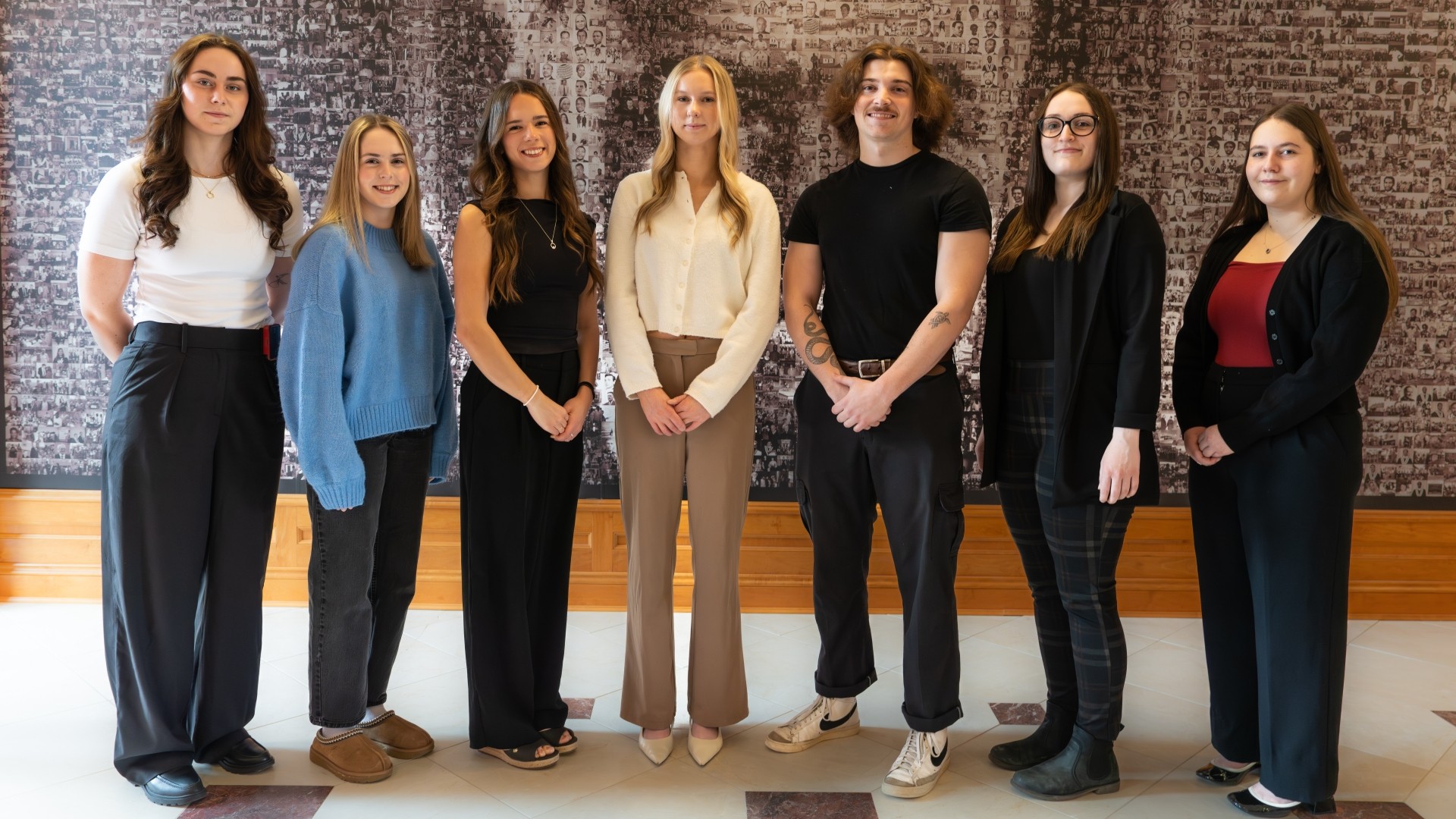
Eight StFX students were able to tackle questions that could shape health policy, challenge cultural assumptions, and rethink how we understand aging, grief, and even sports, thanks to the generosity of the Irving Oil Research Mentorship Award.
The eight students, Abby Mercer, Maya Gibson, Nuala Murphy, Ana Clancey, Nolan Phillips, Morgan Greek, Madison Conrad, and Demarquis Moss, each received $9,250 to pursue a research project under the guidance of a StFX faculty mentor.
Their work ranges from investigating cannabis use and sleep among Canadian undergrads to building a new statistical model for basketball defense, from rural bereavement to the evolving legacy of Anne of Green Gables.
MEANINGFUL CHANGE IN EVERYDAY LIVING
“I am extremely grateful to have been chosen as a recipient of the Irving Oil Mentorship Award. Having the opportunity to get a head start on this research over the course of the summer and continuously deepen my understanding of this subject has equipped me with what I need to carry out a strong study this upcoming year. Aiming to make small strides toward meaningful change in everyday living, to better health and well-being, is incredibly rewarding. I have always dreamed of a career working in healthcare, and the research experience I’m gaining right now makes that goal feel even more achievable,” says Ana Clancey, a fourth year honours student from Halifax, NS.
Ms. Clancey, who is pursuing a BASc in Health degree with a concentration in biomedical sciences, is researching marijuana use patterns and perceived sleep quality amongst undergraduate students, using a mixed-methods approach under the supervision of Dr. Jill Murphy, Research Chair in Mental Health and Addictions. Ms. Clancey will survey students and conduct focus groups this academic year.
They’re hoping to gain a better understanding of the complex relationship between cannabis use and perceived sleep quality, as the two variables are commonly misunderstood. Ms. Clancey says this research upon completion is expected to contribute preliminary evidence amongst a population underrepresented in existing literature, Canadian undergraduate students.
“In addressing this gap in research, I hope findings will be able to inform public health decisions and guide student wellness initiatives on campus.”
Opportunities like this are especially important for students, she says, as they equip future researchers with diverse experiences and allow them to discover their true interests through hands-on experience. In tandem, the award fuels impactful contributions to real-world problems.
GRIEF AND CONNECTION IN RURAL NOVA SCOTIA
Nuala Murphy, a fourth year BASc Health student from Moncton, NB, is examining the role of social participation among bereaved older adults living in rural Nova Scotia. Through qualitative interviews, she’s hoping to better understand how social participation can help mitigate older adults' experiences of grief, particularly in rural communities where opportunities for social connection may be limited.
“I’ve always been interested in healthy aging and the factors that contribute to quality of life as we grow older. Through my health courses, I became interested in the social aspects of aging and how our relationships affect our wellbeing. This sparked my interest in bereavement and the ways loss can affect a person’s social connections and sense of community,” says Ms. Murphy, who is supervised by Dr. Megan MacGillivray. Her second reader is Dr. Jill Murphy.
“Something that struck me during my research so far is how much social participation can encompass. It isn’t just about being involved in large organizations or having a busy social life. Small, everyday interactions can also give people a sense of connection. This has made me think differently about what meaningful social connection looks like for older adults going through major life changes,” she says.
“This experience has given me a new appreciation for how much goes into research before a study even begins. Working through the literature review and ethics process has challenged me to think carefully about my research question and how the study can best serve the people I hope to learn from.”
ANNE OF GREEN GABLES, REVISITED
Maya Gibson, a fourth year honours English student from Halifax, NS, investigated the marginalization of girlhood and how Lucy Maud Montgomery’s Anne of Green Gables challenges preconceptions about girlhood.
Her research looked to understand if newer adaptations of Anne undermine or underline Montgomery’s original messaging about the gender, class, and marginalization of girlhood. She focused on the Megan Follows CBC miniseries of Anne of Green Gables (1985), the annual Charlottetown stage production of Anne of Green Gables: The Musical (1965- present), Anne: The Animated Series (2001), and Netflix’s Anne with an E series (2017).
Ms. Gibson rediscovered the novel in a children’s literature course taught by her supervisor, Dr. Kailin Wright. Rereading it sparked her interest in Anne's various adaptations, and how her character and story have evolved across time.
“This experience has impacted me significantly as it has allowed me to grow as both a writer and a researcher. I had the tools necessary to collect the information I needed for the project, and with the support of the Irving student research award, I had the opportunity to travel to Prince Edward Island and experience the world of Anne of Green Gables firsthand by visiting many iconic landmarks,” she notes.
“Taking on this project over the summer has enhanced my writing skills and sparked a passion for writing, as I have had the privilege of writing about a topic that really interests me and relates to my future career goals.”
IDENTIFYING CANADA’S ‘SUPERAGERS’
Nolan Phillips, a fourth year applied forensic psychology student from Calgary, AB, worked on a project called, “Aging Exceptionally Well: Identifying and Characterizing SuperAgers in the Canadian Longitudinal Study on Aging (CLSA).”
He focused on replicating the CLSA protocol to create a new normative database of younger adults aged 20-45 with a goal to identify SuperAgers, those older adults with exceptional memory. By studying SuperAgers, he says, they hoped to uncover strategies that Canadians can adopt to reduce the risk of age-related memory decline.
Mr. Phillips is supervised by Dr. Erin Mazerolle.
He says one of the most unexpected things he discovered was the challenge of creating a normative database. “I researched effective methods for creating and advertising a normative database, and I found many unique and interesting ways for promoting it. However, as unique and interesting as those techniques were, recruiting participants remained a major hurdle. Finding ways to navigate and overcome those challenges was the most eye-opening part of my research.”
The experience has prepared him well for his future endeavours, he notes, and has taught him a lot about his field and the process of research in general.
RESEARCHING STIGMATIZING ATTITUDES
Morgan Greek, a fourth year applied forensic psychology student from Bridgewater, NS, is researching stigmatizing attitudes towards persons experiencing substance use disorders (SUDs). Specifically, she is investigating to what extent these attitudes are present within correction officers and student populations. She is supervised by Dr. Erin Austen.
“I will be exploring the level of hostile attribution bias within these populations, as well as how quality of contact may play a role in the level of these attitudes.”
Ms. Greek says the most surprising piece of information she found was a single statistic. “Beaudette and Stewart (2016) found that in 2015, alcohol/substance use disorders were identified in nearly 50 per cent of incoming federally sentenced men across Canada. I thought that was an astronomically high number, and considering that was just over 10 years ago, I just had to know more. It was that statistic that sparked the hours long rabbit hole of all research and information I could get my hands on. That single statistic basically kickstarted this whole project.”
This project, she says, reminded her of the importance of persistence and resiliency. “It’s been those two things that make me feel proud about my work and the effort that goes into a thesis. Looking back over this summer, there were plenty of times where I felt overwhelmed and confused, or like I was just spinning my wheels and not getting to where I wanted to be. But, as cheesy as it sounds, the magic happens when you buckle down and keep trying to give it your best shot.”
RETHINKING HOW BASKETBALL VALUES DEFENSE
Abby Mercer, a fourth year honours economics student from Wolfville, NS, created new statistics for basketball to better capture the importance and impacts of defense in player compensation and team success with data from the Men’s National Basketball Association.
Defense is largely effort based and thus hard to quantify, she says. She wanted to find new ways to capture it empirically and see if it was potentially undervalued in determining compensation relative to its impact on team success. “Most professional basketball fans and statistical analysis are offensively biased since it is easier to count and attribute actions to one person and generally seen as more entertaining to casual viewers. It is important to analyze how and why players score, but I think it is also important to analyze why opposing teams don’t score.”
Ms. Mercer, who is supervised by Dr. Patrick Withey, has played basketball since age five and now plays for the X-Women varsity basketball team.
“Growing up I was always known as a more defensive player and was curious why more defensive statistics weren’t collected and why the highest paid professional players scored a lot but sometimes got labelled as ‘bad defenders’ yet still made so much money.”
She discovered one of her new metrics was statistically significant in determining team win percentages but not in determining salary. She notes it presents as a potential opportunity for a sort of Moneyball effect where teams can pay less for players that could have larger impacts on game outcomes through defense than it would cost to obtain players who could have the same magnitude of impact but through offense instead. “This was cool to see in my results since it stems from a metric I created myself. Knowing I made something that has potential to be genuinely impactful and new is exciting as an undergraduate student. It also is interesting to see as a basketball player myself.”
CANNOT UNDERSTATE HOW IMPACTFUL AWARD IS
“I cannot understate how impactful this opportunity was. I was accepted into my graduate program at University of Ottawa because of this work,” says Demarquis Moss, a fourth year honours religious studies and anthropology student from the Bahamas.
“Opportunities like this offer a window into the daily life of a scholar, an invaluable experience for an aspiring scholar like myself,” says Mr. Moss who examined how biblical apocalypticism continues to be used as a manufacturer of otherness into the digital age.
“I’ve always been tapped into internet culture and became fascinated by the 2014-2015 Gamer-gate movement and the subsequent ‘doomer’ internet culture that formed around it. After taking (supervisor) Dr. Sarah Parks’ class on ‘Apocalypse,’ and later becoming a teacher assistant for it, I noticed socio-political similarities surrounding narratives of crises and Christian apocalypticism.”
Mr. Moss says the most interesting discovery is just how contemporary to the present day that their issues sound. “Ideas of nationalism, othering, groupthink, and myth state-building showcases an ongoing dialogue with their material relations. Not only that, but just how much Christian apocalypticism informs narratives of social revolution; and how it is co-opted and wielded by powerful institutions/elites,” he says.