

This summer, an undergraduate research internship at StFX, made possible through the Mitacs Globalink Research Internship program, has led to the resolution of a mathematical conjecture that had remained unanswered for over a decade.
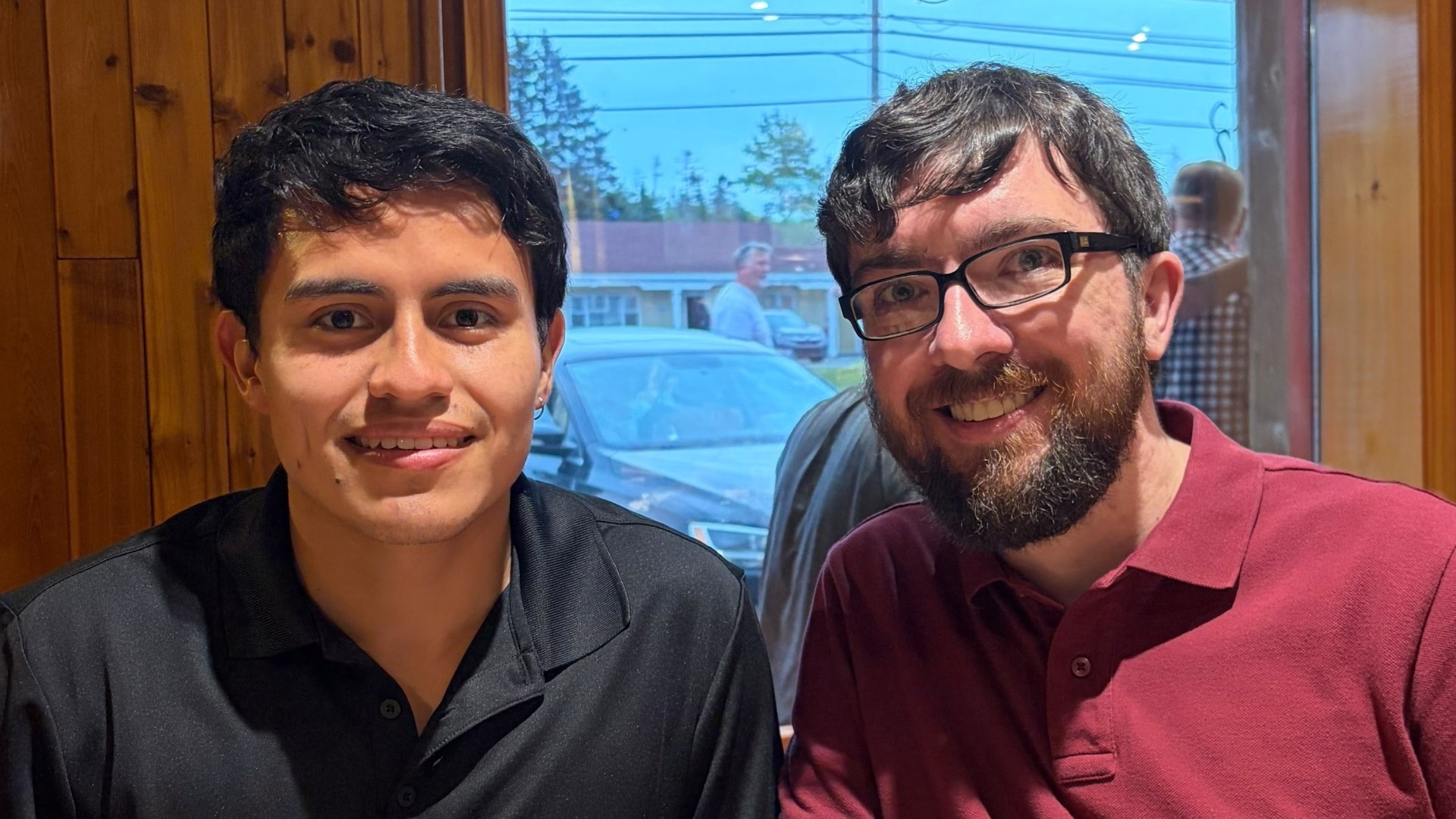
StFX computer science professor Dr. Taylor Smith hosted Diego Cabrera Salamanca, a computer science and mathematics student from the National University of Colombia, for three months in the FLAReLab. Together, they proved a conjecture about Fibonacci words that had stood open since 2015. They also developed an efficient algorithm and code to demonstrate their result.
“The Fibonacci sequence is one of the most famous and well-studied sequences in mathematics, and it is abundant across mathematics, science, and beyond,” Dr. Smith says. In the Fibonacci sequence, each number is found by adding the two before it. Fibonacci words follow a similar pattern, using just two symbols, 0 and 1. Instead of adding, each new term is found by “gluing together” the previous two.
“We considered the question of whether Fibonacci words could be generated via a local process: instead of starting from scratch, could we generate a Fibonacci word by repeatedly copying a short piece of the beginning or end of a shorter Fibonacci word and attaching it to the outside of that word? A conjecture by Marius Dumitran in 2015 suggested that this was possible, but nobody had a sure answer.”
Dr. Smith says this matters because this copying operation belongs to a family of so-called "bio-inspired" operations that model how biological sequences like DNA or genes form and interact, “and if we knew that this copying operation works to generate a rich, highly structured sequence like the Fibonacci words, we could potentially apply it to generate other structured sequences in biology and elsewhere.”
Dr. Smith says Mr. Cabrera Salamanca proved that this 11-year-old conjecture is indeed true: we can generate Fibonacci words via this local copying operation.
In fact, he says they proved one only needs to copy at most three symbols at a time to get their target Fibonacci word, and they only need to copy from the beginning of the word.
“Diego also supplied an efficient algorithm and code to perform this process and demonstrate that our proof works.”
They’ve submitted the paper to Fibonacci Quarterly, an international peer-reviewed mathematics journal. The paper is still under review, but a preprint version of the paper is available HERE at arXiv
“It was truly exciting to work together in an area closely related to my core research, discover an open problem, bounce ideas back and forth, and see these ideas develop into a writeup and eventually a full-fledged research paper,” says Dr. Smith.
He had praise for Mr. Cabrera Salamanca’s accomplishments.
“Diego was more than prepared to tackle the demands of mathematical research, and every time I gave him a paper to read or an idea to mull over, I knew he would come back with some key insight that would push us closer to finding an answer. It was such a pleasure to host him here at StFX.”
“Professor Taylor Smith was an outstanding supervisor,” says Mr. Cabrera Salamanca. “He was flexible and guided me so that selecting the right problem and mastering the fundamentals felt seamless and efficient.”
Mr. Cabrera Salamanca says it was his first time tackling a problem side-by-side with a PhD professor. “Experiencing Dr. Smith’s sharp intuition and years of experience solving complex problems was incredibly rewarding, especially seeing how effortlessly he refined the structure of my mathematical arguments and wrote them out cleanly.”
Coming from the capital of Colombia and from Universidad Nacional de Colombia, which is the largest university in the country with over 57,000 students, he says moving to Antigonish was a major change in terms of community dynamics. “Despite the cultural differences and speaking a second language, I immediately felt the warmth and hospitality of the people. People greeted you on the street, wished you a good day, and shared a strong sense of community across local events. Additionally, meeting other international and local students at StFX allowed me to share incredible experiences and broaden my worldview.
“This research internship has had a profound impact on my life and career,” he says. “It not only broadened my perspective on what academic research truly entails and sparked a deep drive to keep solving problems in computer science, but it also proved to me—and to others—what I am capable of achieving in academia. As a result, it opened doors for me to continue collaborating with exceptional scholars both in Colombia and around the world.”
While at StFX, Mr. Cabrera Salamanca also had the chance to attend two international conferences Dr. Smith organized in Kingston, ON and network with top academics in theoretical computer science.
“Attending CIAA and DCFS was an exceptionally valuable experience. I had the chance to learn about the latest work from leading professors and researchers in theoretical computer science from across the globe, all presenting captivating ideas.”