
FM-PLCY-SW-001- Snow & Winter Conditions Preparedness Policy
Effective Date: April 1, 2026
Prepared by C. Chisholm | Owner: A. VanKessel | Revision: 01
Mission Statement
Facilities Management is committed to working diligently to maintain a safe and accessible campus during severe weather events. This policy operates in alignment with the University’s Unexpected Closures and/or Cancellation of Classes Policy.
Through proactive planning, clear communication, and coordinated response efforts, we aim to minimize disruption, support the well-being of students, staff, and visitors.
Accessibility Accountability
Facilities Management is responsible for supporting compliance with accessibility requirements related to winter maintenance of the built environment.
This includes the planning, execution, and continuous improvement of snow and ice control activities to reduce barriers and support safe, equitable access for all campus users.
Accessibility considerations are integrated into operational planning, priority setting, and post-event review processes.
Operational Capacity and Resource Context
Winter weather response activities outlined in this policy are delivered by the Facilities Management Grounds and Transportation team. At present, the team consists of six (6) operational staff members and one (1) supervisor responsible for winter maintenance activities across the entire campus. Facilities Management may supplement the core team with casual resources, subject to availability, bringing the total operational workforce to up to ten (10) personnel or more, during significant events. Operational planning, prioritization, and sequencing of work during winter weather events are therefore conducted with consideration of available staffing resources, site-wide demands, and prevailing weather conditions. Service levels during significant or prolonged weather events may be adjusted to reflect operational capacity, with priority given to critical access routes, safety-related areas, and Tier 1 facilities as identified in this policy and associated Standard Operating Procedures.
Where capacity constraints exist, mitigation strategies are implemented, including prioritization of critical routes, coordination with contractors, and collaboration with campus partners.
Operational limitations are reviewed as part of continuous improvement and future resource planning.
Definition of Winter Accessible Conditions
In accordance with the Nova Scotia Built Environment Accessibility Standard, pedestrian routes, entrances, and accessible parking areas are to be maintained in a manner that supports conditions that are safe, usable, firm, stable, and slip-resistant.
Facilities Management implements snow and ice control practices to maintain and restore these accessible conditions through prioritized response, inspection, and maintenance activities.
During active winter weather events, conditions may be temporarily impacted by ongoing snowfall, ice accumulation, drifting, or other environmental factors. These conditions are addressed through continuous operational response, with restoration of accessible conditions prioritized as soon as operationally feasible following the reduction or cessation of weather events.
Where conditions have not yet been fully restored, routes are managed to support safe movement until accessibility standards can be re-established.
Key Stakeholders
- Facilities Management Leadership Team
- FM Supervisors and Operations Personnel
- Safety & Security Services (coordination during events)
- Residence & Student Life (housing and access support)
- People and Culture
- Communications & Marketing (public notifications)
- University Housing
- Occupational Health & Safety (accessibility and hazard review)
- Designated Authority Group
Winter Weather Conditions – Operational Definition
Winter weather conditions, for the purpose of this policy, refer to any forecasted or active meteorological event typical of Eastern Nova Scotia that has the potential to impact campus safety, access, or operations. These conditions include, but are not limited to:
- Snowfall (light to heavy), blowing snow, or rapid accumulation
- Freezing rain, ice pellets, or mixed precipitation
- Flash freezes or sudden temperature drops creating ice
- High winds causing drifting, snow load, or visibility reduction
- Rain-on-snow events increasing flooding or runoff
- Winter storm, blizzard, or special weather statements issued by Environment Canada for Antigonish County
These events may occur singly or in combination and often change rapidly in this region. Facilities Management activates winter operations when such conditions are expected to, or do, create safety hazards, mobility challenges, or operational constraints.
Communication Plan
The University Designated Authority is responsible for authorizing and issuing official campus-wide notifications through the StFX Alert system, which disseminates information via social media platforms and campus email. These alerts are reserved for situations in which the University is closed or opening is delayed due to weather conditions.
Facilities Management does not issue campus-wide public messaging; all official notifications are drafted and distributed by Communications & Marketing following leadership approval.
Designated Authority
Decisions related to University closure, partial closure, or class cancellation during winter weather events are made by the Designated Authority, as defined under the Unscheduled Closure and/or Cancellation of Classes Policy.
Operational Communication Flow
During winter weather conditions, the Grounds and Transportation Supervisor will communicate operational updates and conditions to the Maintenance Manager, who will escalate relevant information to the Director of Facilities Management. The Director will then brief the University Designated Authority group on campus readiness, anticipated impacts, and operational constraints.
If a campus closure or delayed opening is being considered, the University Designated Authority group will make the final decision. Once a decision is reached, Communications & Marketing will issue the official University-wide notification through established channels, including StFX Alert system, email, and social media.
University-wide closure and employee attendance expectations are governed by the University’s Unexpected Closure and Cancellation of Classes Policy. Facilities Management’s storm operations support this framework but do not replace or interpret the University policy.
Daily Weather Briefs
In the lead up to an adverse weather event, the Grounds and Transportation Supervisor prepares a “Daily Brief” that is shared with FM Leadership as well as Safety & Security Services. The brief highlights what the potential event may look like, resource allocation and availability before, during, and after the event.
Priority Areas
Winter maintenance will follow a tiered priority structure as follows:
Tier 1 – Student Safety and Essential Services
Scope:
- Primary entrances to all residence halls
- Main pedestrian paths linking residences to dining services
- Accessible entrances to essential student services (Morrison Hall, *Library), and operational support areas (Facilities Management, Safety & Security Services)
- Pedestrian access route between 30 West Street and the campus core to ensure uninterrupted access for Residence Life Coordinators (RLCs)
During active weather events, Tier 1 routes are continuously monitored and cycled as conditions allow. Due to ongoing accumulation and environmental factors, conditions may temporarily degrade between maintenance activities.
Rationale:
These routes support students living on campus, emergency responders, and essential daily services.
Tier 2 – Academic and Administrative Access
Scope:
- Main entrances and primary walkways serving academic and administrative buildings
Rationale:
Once Tier 1 routes are stable, attention shifts to the routes required for academic and administrative operations.
Tier 3 – Secondary Access
Scope:
- Secondary entrances and lower-traffic walkways serving residential, academic, and administrative buildings
Rationale:
These areas are addressed after primary networks are cleared.
Tier 4 – Post-Storm Recovery
Scope:
- Storm drains
- Loading docks
- Roof access points and areas requiring mechanical snow removal
Rationale:
These activities mitigate flooding, maintain building operations, and address structural or safety concerns once pedestrian and entrance access has been restored.
How Priorities Progress During a Storm
During active winter weather conditions, members of the University community should anticipate that access may be limited to designated primary entrances and priority routes. Users are encouraged to plan their travel, accordingly, allow additional time for movement across campus, and use established cleared pathways wherever possible, as outlined in Appendix B.
Where access challenges are encountered, individuals are encouraged to report concerns through the Facilities Management Service Desk or Safety & Security Services to support timely response.
- Facilities Management remains focused on Tier 1 until conditions allow advancement.
- Each tier is completed to a functional standard before proceeding to the next.
- Detailed, route-by-route responsibilities are maintained internally to support staff deployment, training, and operational planning.
Primary Entrances and Managed Access During Winter Conditions
- During winter weather conditions, Facilities Management prioritizes maintaining access to all campus buildings through designated primary entrances and priority routes. While access to all campus buildings is supported through designated primary entrances, not all entrances or secondary access points can be cleared or treated simultaneously during active weather events or periods of limited operational capacity.
- As a result, building occupants may be required to use primary or designated entrances (Please note Appendix B) that can be cleared and maintained most efficiently during winter conditions. Requests for clearing of secondary or side entrances are addressed as conditions permit and in accordance with established prioritization and resource availability. Users are encouraged to contact the FM Service Desk or Safety & Security Services team if any concerns arise.
Accessible Route, Entrance, and Parking Maintenance Plan
- Facilities Management maintains a structured winter maintenance plan to support safe, accessible movement across campus during winter weather conditions.
- This plan establishes the approach for maintaining accessible routes, building entrances, and designated accessible parking areas through proactive planning, prioritized response, and continuous monitoring of conditions.
Barrier Identification and Removal
- Facilities Management is responsible for identifying and reducing physical barriers to accessibility within the campus environment through routine inspections, operational activities, and stakeholder engagement.
- Members of the University community, including students, staff, and visitors, are encouraged to report accessibility barriers as they are identified. Reports may be submitted through the Facilities Management Service Desk or Safety & Security Services to support timely response and resolution.
- Accessibility challenges identified through operations, inspections, or community reporting are documented, tracked, and reviewed to inform operational improvements, maintenance planning, and future capital upgrades.
- Where feasible, corrective actions are prioritized to enhance accessibility and align with the University’s broader accessibility objectives and legislative requirements.
Accessible Parking Priority
- Designated accessible parking spaces and associated access aisles will be prioritized for snow and ice clearing and treatment. These areas will be maintained to support safe vehicle access, deployment of mobility devices, and unobstructed travel to adjacent accessible routes and building entrances.
Clearing Timelines for Accessible Parking
- Accessible parking spaces will be addressed as a priority within winter maintenance operations and cleared as soon as operationally feasible following the onset or accumulation of snow and ice, in alignment with Tier 1 priorities and prevailing operational capacity.
Maintenance Activities
Maintenance activities under this plan include:
- Prioritized clearing and treatment of accessible entrances, pedestrian routes, and designated accessible parking areas
- Application of snow and ice control measures (e.g., plowing, salting, sanding)
- Ongoing monitoring of conditions during active weather events
- Post-event inspections to identify and address residual accessibility barriers
All maintenance activities are guided by the tiered priority framework outlined in this policy and are adjusted based on weather conditions, operational capacity, and campus-wide needs.
Back-Up and Resourcing
Facilities Management will maintain:
- External Contractor: A qualified snow-removal company is retained annually to maintain the University’s main streets, parking lots, and vehicular routes. The contractor operates under the direction of Facilities Management and coordinates with the Grounds and Transportation Supervisor to align roadway and parking maintenance with pedestrian clearing activities.
- Casual Support: During significant or prolonged snow events, Facilities Management engages casual employees to assist the full-time Grounds team. These additional staff provide manual support to building entrances, stairs, and walkways to ensure the campus remains safe and accessible during periods of heavy accumulation.
- Facilities Management ensures appropriate accommodations, meals, and rest areas are provided for essential staff during prolonged weather events.
- A stocked inventory of salt, sand, and equipment is positioned at various locations throughout the campus, for rapid deployment.
- In addition, an emergency utility trailer is equipped and ready for immediate use, containing essential response equipment such as wet/dry vacuums, a generator, blowers, extension cords, pumps, and personal protective equipment (PPE). This mobile unit enables FM teams to respond quickly to flooding, power outages, and weather-related incidents that threaten safety or accessibility.
- Facilities Management is not a 24-hour operation.
- Regular snow and ice control activities occur between 6:00 a.m. and 6:00 p.m. There is no routine coverage between 6:00 p.m. and 6:00 a.m. During adverse weather or emergency conditions, Facilities Management may adjust resource availability to reflect evolving conditions, while maintaining a focus on the health and safety of Facilities Management staff. During non-routine coverage, only critical response activities are undertaken at the discretion of Facilities Management leadership, in coordination with Safety & Security Services.
- After-hours conditions are monitored by Safety & Security Services. Where critical accessibility barriers are identified, Facilities Management will respond on an on-call basis to address urgent issues.
During prolonged or significant winter weather conditions, Facilities Management may implement snow accumulation management measures when on-campus storage capacity becomes limited or when conditions warrant additional mitigation. This may include the removal and off-site hauling of accumulated snow by an external contractor.
Snow hauling is typically considered following multiple snow events (generally two to three typical accumulation events), or sooner where a substantial single snowfall, site-specific concern, or operational constraint impacts safety, access, sightlines, or the effectiveness of ongoing winter operations.
Decisions related to snow hauling are made by Facilities Management leadership based on observed conditions, forecasted weather, available storage capacity, and operational priorities.
Accessibility Review
Following each winter weather event, and in alignment with the Accessible Route and Entrance Maintenance Plan, and once primary snow-clearing and treatment activities have been completed, Facilities Management leadership or the designated Supervisor will conduct a post-event accessibility walk-through of campus. This review will focus on identifying and addressing any remaining barriers that could impede safe access for students, employees, and visitors. Leadership across campus is encouraged to review their respective areas where feasible and report any accessibility concerns.
Facilities Management recognizes that accessibility considerations during winter operations may vary across campus and may include both permanent and temporary needs. While winter response activities prioritize maintaining safe access to buildings and key routes, Facilities Management works collaboratively with campus partners (Residence Life and People and Culture) to understand emerging accessibility considerations and to inform operational planning where feasible.
Accessibility-related considerations and access challenges are reviewed as part of ongoing and end-of-season evaluations, with the intent of informing future refinements to winter operations, communication practices, and coordination approaches. These reviews support a continuous improvement model rather than a one-size-fits-all approach.
Winter Weather & Special Events Coordination
During winter weather conditions that coincide with scheduled University events, the Facilities Management Grounds and Transportation Supervisor will coordinate directly with the Events Services team to ensure safe access for participants, staff, and attendees.
This coordination will include:
- A review of weather forecasts and anticipated impacts on event venues
- Confirmation of exact venues being used
- Confirmation of entrance and exit routes requiring priority attention
- Identification of any mobility or accessibility requirements
- Adjusted snow clearing, salting, or drifting mitigation plans
- Additional pre-event inspections or walk-throughs as needed
- Communication of risks, timing adjustments, or access limitations to Events Services
Event venues to consider (these venues are subject to change based on the need (s) of the event in question.)
- Charles V. Keating Centre
- Amelia Saputo Centre
- Brian Mulroney Institute of Government
- Markin Complex
- Bloomfield Centre
Facilities Management reserves the right to restrict or modify access to any venue if conditions present safety concerns.
Review and Version Control
End-of-Season Review
This policy, including supporting appendices, will be reviewed annually prior to the winter season or following any major winter weather event that tests or alters operational practices.
The review will be coordinated by the Facilities Management Leadership Team in consultation with key stakeholders such as University Communications, Occupational Health & Safety, and Safety & Security Services.
Updates will be approved by the Director of Facilities Management and communicated to all relevant personnel.
Operational End-of-Season Debrief
At the end of each winter season, critical Facilities Management team members will convene to conduct an operational debrief. This debrief will review successes, challenges, and opportunities for improvement based on the season’s events and response activities. Insights from this process will inform updates to operational procedures, resource planning, and future winter-readiness preparations.
References
Nova Scotia Accessibility Act, S.N.S. 2017, c. 2.
Built Environment Accessibility Standard, N.S. Reg. 48/2025.
Appendix A: Priority Buildings and Pathways
Tier 1 – Student Safety and Essential Services
Residential Buildings:
- MacIsaac Hall
- Mount St. Bernard
- Riley Hall
- O’Regan Hall
- Governors Hall
- FX Hall
- Power Hall
- Somer Hall
- Cameron Hall
- Bishop Hall
- Mockler Hall
- MacKinnon Hall
Essential Student Services:
- Morrison Hall
- MacDonald Hall
- *Angus L. MacDonald Library
- *Charles V. Keating Centre
- *Amelia Saputo Centre
- 30 West Street
*Conditional Tier 1 Facilities:
The following facilities may be prioritized as Tier 1 locations during winter weather conditions under specific conditions:
- The Angus L. MacDonald Library will be prioritized as Tier 1 facility when a directive is issued by the Office of the Academic Vice President (or designate) indicating that Library operations are required during a University weather-related closure.
- The Charles V. Keating Centre/Amelia Saputo Centre will be prioritized as a Tier 1 facility when a public event is scheduled to proceed and has not been cancelled, requiring safe access for participants, staff, and attendees.
Tier 2 – Academic Access
Primary Academic & Administrative Buildings:
- Brian Mulroney Institute of Government
- Nicholson Tower
- Gerald Schwartz School of Business
- Nasso Family Science Centre
- Annex
- Bloomfield Centre
- Coady Institute
- Gilmora Hall
- J. Bruce Brown
- Rankin School of Nursing
- Xavier Hall
- MacKinnon Hall
- 42 West Street
Tier 3 – Secondary Access
Secondary building entrances and lower-traffic walkways for:
- All academic buildings
- All administrative buildings
- All residential buildings
- All non-academic buildings
Secondary routes cleared once primary network is stable.
Tier 4 – Post-Storm Recovery
Campus-Wide Recovery Tasks:
- Storm drains
- Loading docks
- Roof access points
- Obstruction points
- Snowbanks
- Wind-drift accumulation
- Blocked sightlines
- Other post-storm obstructions
Obstruction points normally require mechanical removal or targeted mitigation.
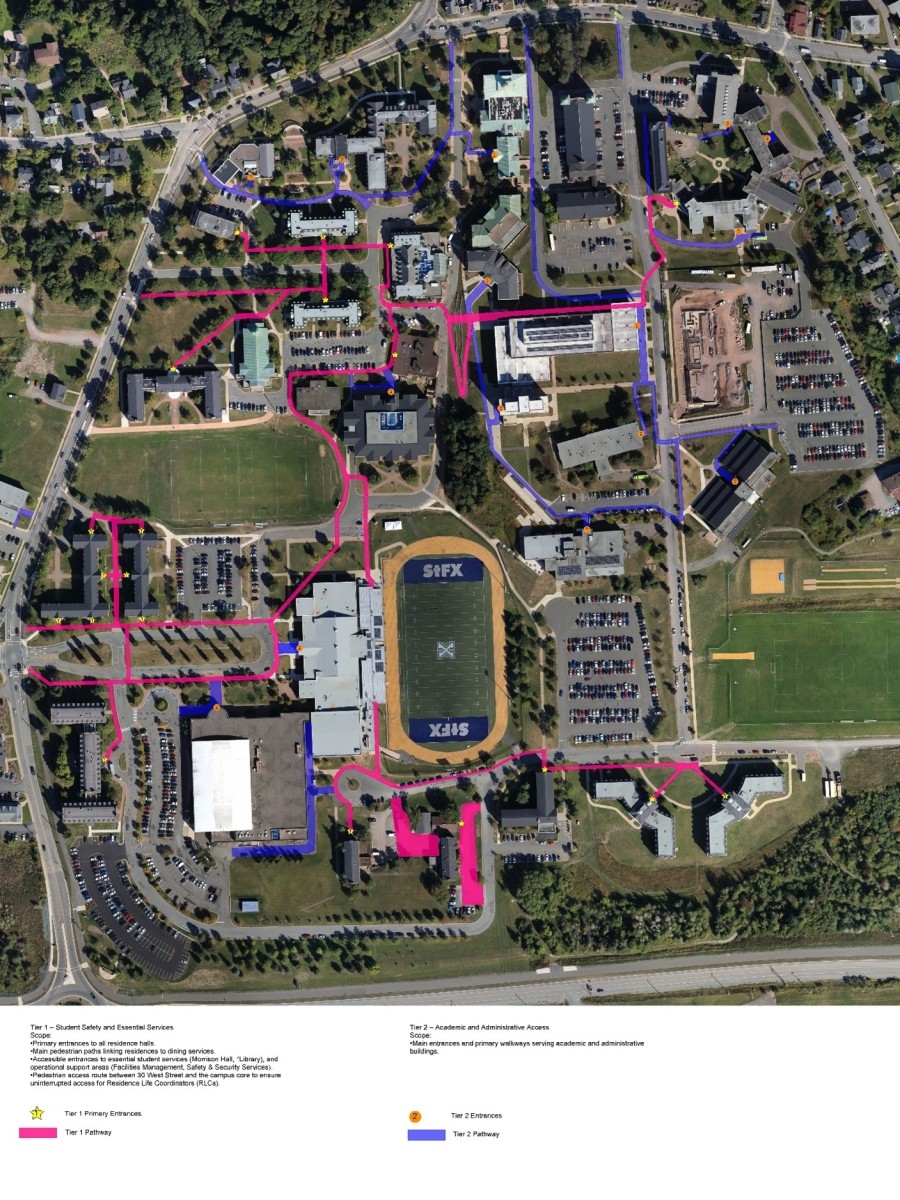
Appendix B: Snow Clearing Priority Map
This map illustrates the priority routes, building access points, and operational zones referenced within this policy.
It is intended to support understanding of the tiered snow clearing approach and to provide a visual reference for campus users and operational teams.
The map is reviewed and updated periodically to reflect changes in campus infrastructure, accessibility requirements, and operational priorities.