

Research X’cellence: Our StFX community leveraging expertise on today’s most pressing challenges. At StFX, innovative research and creative activity are benefiting our communities, addressing some of today’s most pressing challenges. Research X’cellence shines a spotlight on members of our inspiring educational community and the impact they’re making. (To see the full series, please click HERE.)
Dr. Jantina Toxopeus: Understanding ticks, spruce budworm, and life at the edge of survival
StFX biology professor Dr. Jantina Toxopeus has centred her research on a question most Canadians can relate to: how do living things survive winter? Broadly, her work focuses on understanding how insects and other animals withstand extreme cold, and what their survival strategies can tell us about both fundamental biology and the impacts of climate change.
Among the species she studies are black-legged ticks and spruce budworm. Black-legged ticks are known for carrying Lyme disease, though not every tick carries the pathogen. Interestingly, she says some evidence suggests ticks that do carry the pathogen may survive winter better than those that do not. Dr. Toxopeus is working to determine why this occurs and how pathogen presence might influence winter survival.
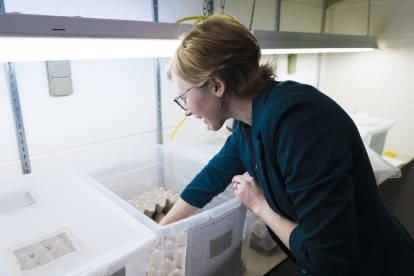
Her research also examines the spruce budworm, a tiny forest pest insect native to Canada that causes major damage. Although small, spruce budworms grow rapidly as they feed on spruce trees. Historically, outbreaks occur every 40 to 50 years and can devastate spruce populations. Currently, an outbreak is ongoing in Quebec, another appears to be contained in New Brunswick, and a new one is beginning in Nova Scotia’s Cape Breton region, she notes, where a major outbreak also occurred in the 1970s.
Dr. Toxopeus and her team are trying to understand how spruce budworms survive winter, and how temperature affects their biology. The insects appear to struggle with warmer fall temperatures, and her research aims to uncover how temperature interacts with their physiology and overall survival.
Another part of her work focuses on crickets that are able to survive freezing, which is an unusual biological ability. “It’s a unique thing. Many animals cannot do that.” By studying these crickets, Dr. Toxopeus hopes to uncover what changes occur in their cells, tissues, and genetic expressions that allow them to prepare for and survive freezing conditions.
Dr. Toxopeus says she has been interested in biology for a long time. She recalls always being drawn to the small-scale aspects of science, such as cells, and remembers learning about genes in Grade 8 and thinking it was amazing. During her master’s degree, a conference presentation about freeze-tolerant crickets helped define her path. “I thought it was cool.”
While winter is an ever-present topic for Canadians, she jokes, what truly captured her attention was the idea of life at the extremes. “That there are organisms out there that can just survive conditions that we can’t even begin to survive.” She became interested in learning about the limits of biology and the organisms that push those limits.

Although the subject initially fascinated her, Dr. Toxopeus says she also wanted her research to have real-world impact. With winters changing due to climate change, understanding how insects survive the cold can help scientists predict what may happen next. In general, understanding how these organisms survive winter is key to predicting how their survival might change in the future, including whether they may migrate into new areas. “Often what limits where insects can live is how cold it will get.”
Climate change may already be helping black-legged ticks expand their range, making this research especially important from a public health perspective. Similarly, better understanding the biology and behaviour of spruce budworm could help the forestry industry adapt its strategies for dealing with the pest.
Dr. Toxopeus says she is motivated by a love for learning about the world and also wanting her work to make a difference. Her research, she notes, is a balance between knowledge gain and helping people.
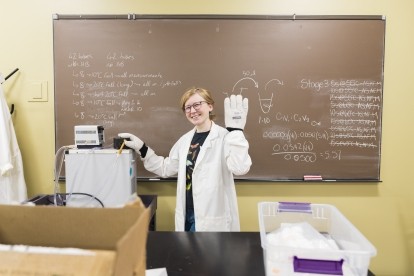
She has been conducting this research for the past decade, including during her PhD and postdoctoral appointment. Dr. Toxopeus, a 2011 StFX biology graduate, joined the department as a faculty member in July 2020.
She teaches cell biology and animal biology, as well as new courses on extreme adaptations, and the biological research experience.
Dr. Toxopeus says she is thankful that she has received research funding from a variety of sources. Each year, she supervises between three and six students in her lab. Working with students is the part of her job she enjoys most. “There is something special seeing someone else do research for the first time…helping them learn to be a scientist and teaching them how to be a researcher.”