

Research X’cellence: Our StFX community leveraging expertise on today’s most pressing challenges. At StFX, innovative research and creative activity are benefiting our communities, addressing some of today’s most pressing challenges. Research X’cellence shines a spotlight on members of our inspiring educational community and the impact they’re making. (To see the full series, please click HERE.)
Building towards a cleaner future: light driven green hydrogen production
A recent discovery by two St. Francis Xavier University chemistry faculty aims to contribute to Nova Scotia and Canada’s transition to green energy.
Dr. Geniece Hallett-Tapley and Dr. Erwan Bertin have focused their collective research interests on developing a novel route for green hydrogen evolution. Their collaborative approach has led to the design of a new, multi-component solid that, upon exposure to both artificial and natural solar light, efficiently generates hydrogen gas. Dr. Hallett-Tapley and Dr. Bertin both stress that this means of clean hydrogen generation will not only improve the sustainability of current industrial processes that are reliant on excess electricity or heating sources, but it would also allow for improved accessibility to clean energy technologies, particularly in remote and rural regions.
Hydrogen is used in industries ranging from fertilizers to fuel cells, but most of the world’s supply is still produced from high energy thermal methods, including natural gas reformation. As Drs. Bertin and Hallett-Tapley mention, this approach is far from ideal. Both stressed that the natural gas route consumes roughly two per cent of global electricity, while significantly contributing to greenhouse gas emissions, producing 12 times more carbon dioxide than the desired hydrogen product. These significant drawbacks were the driving force for Dr. Bertin and Dr. Hallett-Tapley’s recent collaboration, by capitalizing on their common areas of interest to discover greener and cleaner routes of clean hydrogen production—a major goal of global energy transition efforts.
AN UNEXPECTED DISCOVERY
The StFX researchers didn’t originally set out to develop a hydrogen system. Their collaboration began when Dr. Hallett-Tapley’s former MSc student, Yashodha Panagodage, noticed unexpected results involving a catalyst in 2022.
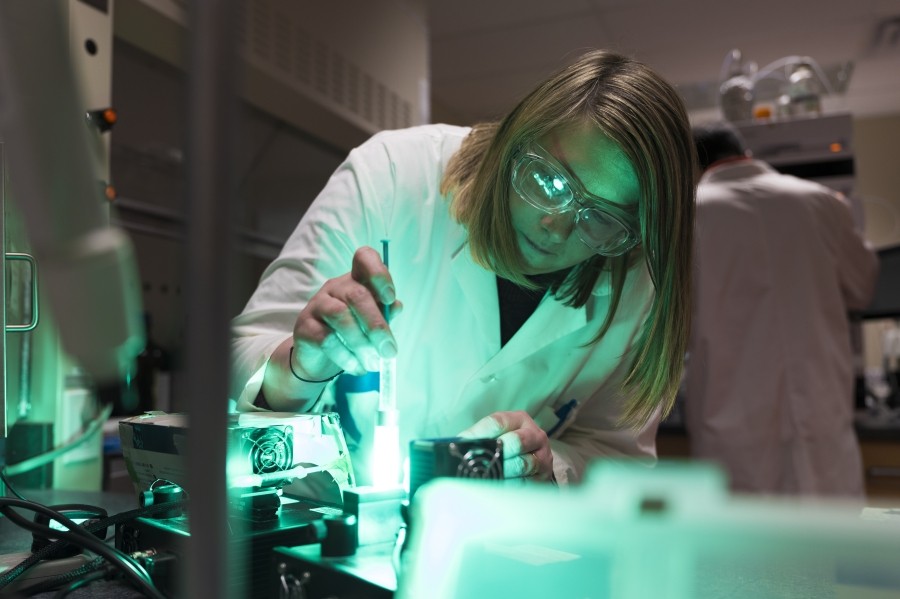
On suspecting hydrogen production, Dr. Hallett-Tapley approached Dr. Bertin to discuss the findings. Using equipment housed in Dr. Bertin’s lab for gas detection, the researchers were not only able to confirm the presence of hydrogen but discovered that the amount of hydrogen being generated was much greater than they both anticipated. Further quantification demonstrated that the unexpected discovery was capable of producing ~ 100 times more hydrogen than established light-activated methods.
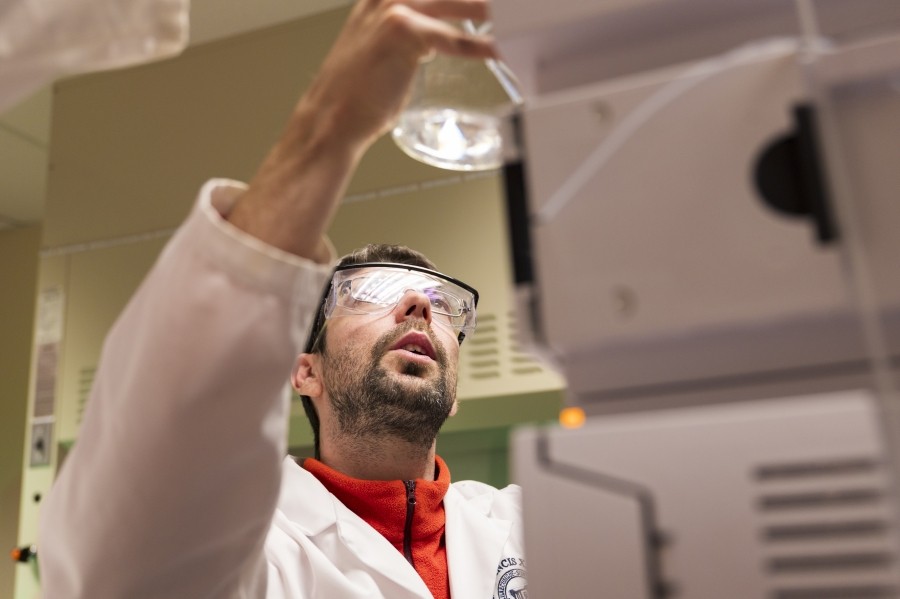
Hydrogen generation was not the main objective of this project. “It was one line in a five-page proposal that spoke to the future promise of hydrogen,” Dr. Hallett-Tapley said. Since this discovery, it has evolved into a fully independent research project, with the support of Net Zero Atlantic. Several StFX undergraduate students have since worked exclusively on the research, helping quantify the hydrogen produced and testing different solid materials and light sources. In the lab’s system, the catalyst interacts with light to release hydrogen as a byproduct.
Dr. Hallett-Tapley said undergraduate involvement has been central to the project. “It’s been primarily undergraduate students who have driven this work,” she noted, adding that such extensive hands-on experience is unusual at the undergraduate level and strongly speaks to and supports the StFX vision to offer a world class undergraduate experience. The experience will serve the students well, Dr. Bertin adds, especially given growing attention on climate change and potential contributions from the clean energy sector. There will be an ongoing need for professionals who can measure and monitor hydrogen production, he says. Both researchers say the long-term societal impact of clean hydrogen drives their work. They also aim to show students that scientific innovation is within reach and often originates from the unlikeliness of sources.
NO ELECTRICITY NEEDED
A promising aspect of the process is that it does not require an external power source.
“The sunlight is our power,” says Dr. Hallett-Tapley, who adds, “Using this renewable and abundant energy source will allow for broader use of the technology.” She explains this will expand the ability for implementation in rural and remote areas, common for many locations in Nova Scotia and Canada, as a whole. “We’re short on electricity in the province,” says Dr. Bertin “and being able to use something that doesn’t require electricity can be viewed as another large benefit of this discovery.”
Since the conceptualization of this work, Dr. Bertin and Dr. Hallett-Tapley have continued to seek funding and support to see the overall goal of Phase 1 industrial application trials come to fruition. The project has expanded beyond the Chemistry Department and is now in reactor design and scale-up phase with the help of Dr. Brittany MacDonald-MacAulay from the Department of Engineering. Preliminary results are promising, the researchers say. The recent support from local industries with clean fuel interests will only help to improve the impact of this homegrown discovery. Dr. Bertin and Dr. Hallett-Tapley both mention they are looking forward to seeing what comes next.