

Research X’cellence: Our StFX community leveraging expertise on today’s most pressing challenges. At StFX, innovative research and creative activity are benefiting our communities, addressing some of today’s most pressing challenges. Research X’cellence shines a spotlight on members of our inspiring educational community and the impact they’re making. (To see the full series, please click HERE.)
For Dr. Dave Risk, a global leader in methane measurements, it’s all about science into impact
One of the world’s largest teams dedicated to methane measurement is housed in a busy lab on the StFX campus. At its forefront is Dr. Dave Risk, an earth and environmental science professor and Research Chair in Climate Science and Policy at StFX’s Brian Mulroney Institute of Government.
“I see science as a tool to solve problems in society. I like the impact,” says Dr. Risk who has spent the past two decades working to develop better ways to measure and manage greenhouse gas emissions, particularly methane, one of the most potent contributors to global warming.
Dr. Risk leads the FluxLab, a group of about 25 researchers, including undergraduate students to postdocs, often asked by waste companies, oil and gas operators, government, industry, and agencies to help develop tools, run field tests, and improve emissions tracking. More than two-thirds of their work is international.
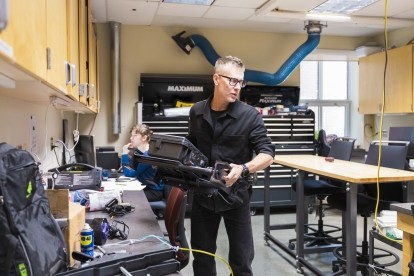
"Most people come to us for answers, to develop a tool to measure," he says. "We're trying to answer people's questions."
“Most people come to us for answers, to develop a tool to measure,” he says. “We’re trying to answer people’s questions.”
One of their most high-profile projects is the Simulation Facility for Landfill Emission Experiments (SIMFLEX) — a pioneering 30-acre controlled emissions research facility in southern Ontario that Dr. Risk’s lab operates on behalf of a nonprofit called the Environmental Research and Education Foundation, representing the major North American waste companies. It is the only site of its kind in the world where measurement companies can test their methane detection technologies under realistic conditions.
“It looks and acts like a real site, with complex wind patterns,” said Dr. Risk. Vendors can see how their tools perform in a real-world environment.
The FluxLab runs two measurement campaigns a year. This past spring, 25 participants from seven countries took part in a testing campaign at SIMFLEX. Dr. Risk’s lab also tested its own in-house technology.
“You can’t manage what you can’t measure,” Dr. Risk says.
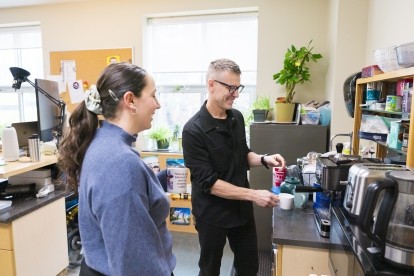
Testing is important. When people understand their emissions better, they become more accountable, he says, and often see dramatic improvements. “I really like being in these conversations,” says Dr. Risk who sees it as an extension of his work to help regulators make better decisions through access to better data.
NOVA SCOTIA AND THE WORLD
During the past year alone, the FluxLab delivered projects on three continents and collaborated with space, air, and ground-based sensor companies in eight countries. Fluxlab has conducted measurement campaigns across the country to help Canada report emissions more accurately. While the work has taken them across the country, and the globe, their research is also rooted in issues at home in Nova Scotia.
The province has significant methane sources, including landfills that lack collection systems, as well as potential emissions from agriculture and legacy coal activity. These would be better managed if we measured them more, Dr. Risk says. As Nova Scotia explores oil and gas development, he says accurate measurement will be essential if we are to keep up with the best-regulated jurisdictions.
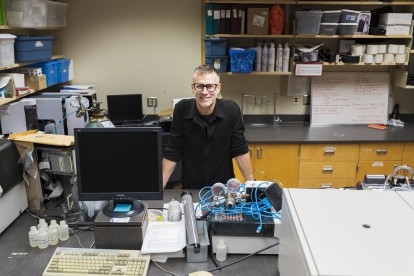
The FluxLab has much expertise. They’ve worked extensively with oil and gas producers and regulators in western Canada for 15 years with great outcomes in reducing greenhouse gas emissions.
Nova Scotia may also soon be positioning itself as a leader in hydrogen, with a potential North American-leading initiative in the works to locally generate electricity for hydrogen production. That hydrogen could be used like natural gas. “You get the possibility of a fossil fuel but it’s clean burning.”
Dr. Risk, who’s involved in an International Energy Agency panel making recommendations on how to manage hydrogen, is in conversation with the people behind the proposed wind farm project.
IN DEMAND EXPERT, NEW COMPANIES
Dr. Risk’s journey into science wasn’t linear. He began university as an arts student but shifted paths after being inspired both by a scientist uncle and discovering he could spend time outdoors while earning his degree. Today, he still credits his arts background with broadening his perspective and making him comfortable reaching across the fence to understand people’s information needs.
Another turn in his road came in 2000 when he arrived at StFX to start his master’s degree. Research work on gases in the soil as part of forestry operations piqued his interest in equipment and methods and started his journey towards equipment measurement scientist.
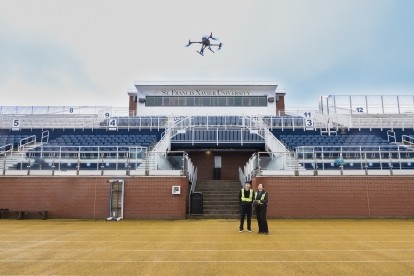
Now as faculty at StFX, he teaches classes on the energy transition, climate science, and field-based environmental studies.
Since founding the FluxLab in 2006, he’s become an in-demand expert, earning accolades from early recognition in his career from the Royal Society of Canada and is regularly sought out internationally as a speaker, giving invited talks as far away as Australia.
Additionally, several companies have spun out of his lab, and alumni have gone on to roles in government, tech startups, and climate initiatives.
Dr. Risk says the work of the FluxLab is all about impact, in trying to reduce the carbon intensity of energy production, to make better energy choices, and have cleaner air. “I do believe in, and we have to address climate change. It’s very real. It’s very obvious.”