

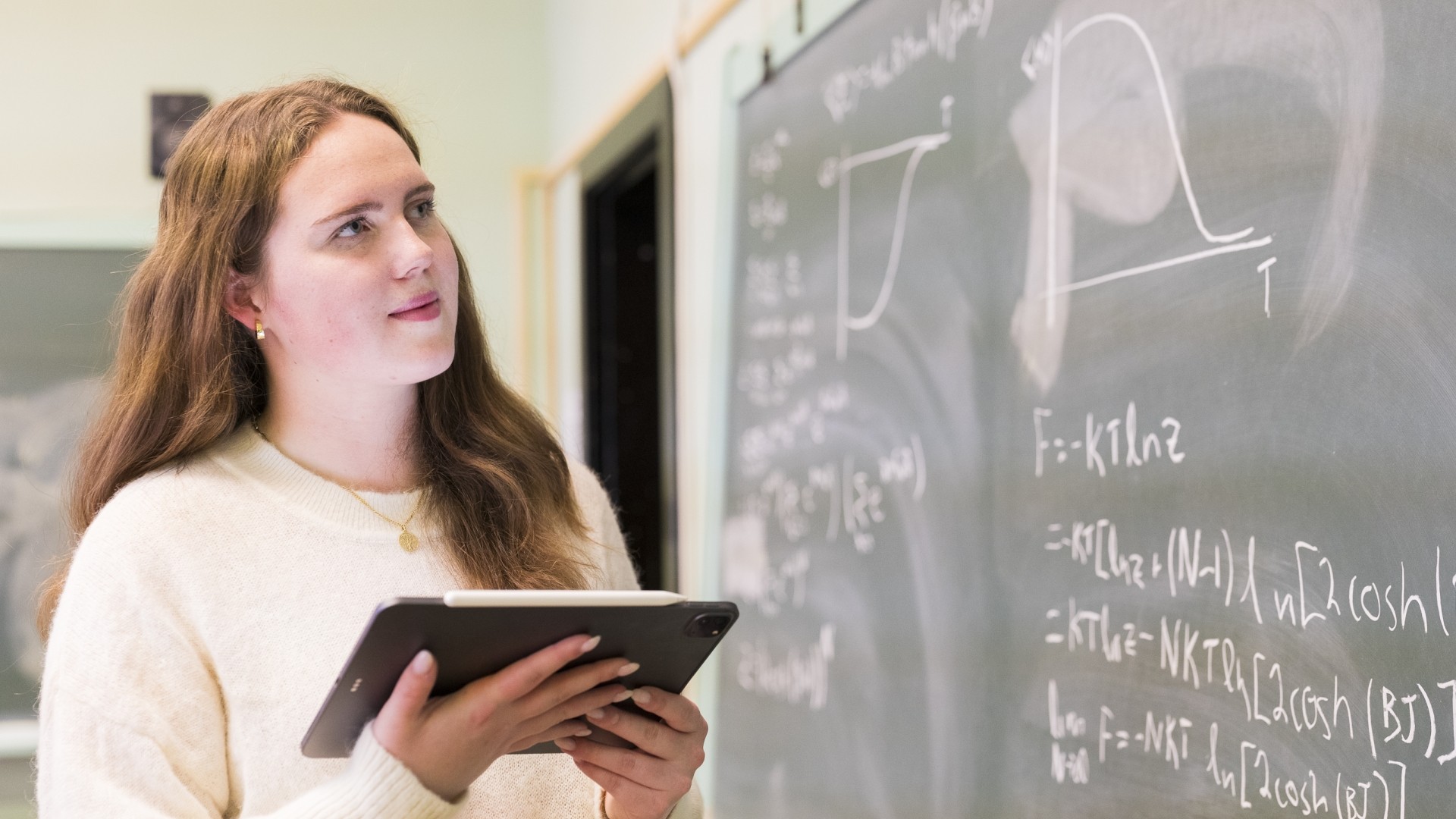
When Keely Ralf of Jasper, AB arrived at St. Francis Xavier University, she knew she loved physics, but not where it would take her. Now, before even crossing the stage at graduation this May, she has co-authored a paper in Science, one of the most prestigious research journals in the world. It’s known to only publish work likely to have a major impact.
“I’m really grateful,” says Ms. Ralf, who has worked the past two summers as a research assistant with StFX physics professor and paper co-author, Dr. Peter Poole. “I’m so glad I came to StFX and worked for Dr. Poole. What an experience I’ve had, and the cherry on top is this paper closing out my degree. It’s been an incredible experience.”
The publication, Experimental evidence of a liquid-liquid critical point in supercooled water, marks a major scientific milestone with experimental evidence supporting a long-debated idea about the strange behaviour of water.
“Water is everywhere, but water is weird,” says Dr. Poole, who has studied the substance for over three decades, and was a co-author on another global collaboration in Science in 2020.
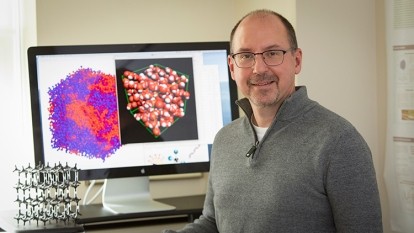
Back when Dr. Poole was a PhD student in Boston in the 1990s, his supervisor proposed a controversial idea, that something dramatic was going on with water in exotic conditions. Far below freezing and under pressure, he surmised water might have a new transition.
The theory helped explain some of water’s unusual properties, but it remained unproven. The key prediction, a special point called the “critical point” in deeply cooled water, had never been directly observed.
Until now.
The new study, involving 25 researchers across Germany, Sweden, South Korea, and Canada, pushed water into extreme, deeply supercooled conditions, where it remains liquid below its normal freezing point.
International news articles from the paper:
- https://www.sciencenews.org/article/water-critical-point-supercooled-liquid
- https://www.chemistryworld.com/news/scientists-claim-to-have-found-the-two-types-of-water-that-explain-the-liquids-oddness/4023193.article
- https://phys.org/news/2026-03-ray-lasers-enable-discovery-critical.html#google_vignette
Capturing what happens is difficult. Water tends to crystallize into ice almost instantly, leaving only fleeting moments to study its liquid state, Dr. Poole says.
To overcome that, researchers created samples in Germany and Stockholm and shipped them to South Korea where they used ultrafast laser pulses and rapid X-ray measurements, racing against time to observe the transition.
The result is the first experimental evidence consistent with the long-predicted critical point, where water shifts between two liquid states.
While the experimental work took place overseas, Dr. Poole and Ms. Ralf were the team members focused on theory and simulation.
Their job was to help interpret and create simulations of the data.
“We were helping interpret what the experiments were seeing,” says Ms. Ralf, “building simulations to understand what the data was telling us and narrow the analysis.”
For Ms. Ralf, that work became transformative.
The research helped her discover her love for computer simulation and condensed matter physics. “Being able to build computer simulations to explain physical phenomena is fascinating,” she says.
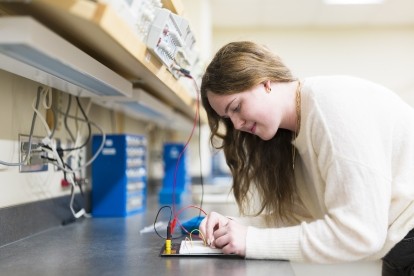
Her path into the project began with earlier research on the Ising model, a mathematical framework used to study phase transitions. After her first summer working with Dr. Poole, she presented her work at a national conference, earning a student choice award. The following summer, she received a Natural Sciences and Engineering Research Council (NSERC) grant to continue her research. She also presented at the Canadian Undergraduate Physics Conference, experiences she says were meaningful.
Ms. Ralf is the only undergraduate author on the paper, and this may be the first time that a current StFX undergraduate has appeared as an author in Science, according to Dr. Poole.
“It’s a goal I’ve long had at StFX,” he says on his desire to have an undergraduate student publish at such a significant level. “I believe in what we do here, and that we can engage students in research at the highest level.”
He credits both the Physics Department, and StFX as a university, for encouraging undergraduate research and making opportunities like this possible.
“It’s not where you are, but what you do,” he says. “Being at a smaller university doesn’t limit you. It doesn’t mean you can’t be part of a sophisticated, international collaboration.”
Beyond the achievement itself, the research has important implications.
Understanding water’s behaviour under extreme conditions helps scientists refine models used across physics, including in atmospheric science. That, in turn, plays a role in understanding such phenomenon as cloud formation and climate systems.
“Water is a very important substance, and it’s still not fully understood,” Dr. Poole says.
For Ms. Ralf, the experience has helped shape what comes next. She plans to pursue graduate studies.
After years of research, seeing the work culminate in a publication of this magnitude is deeply rewarding.
“It’s super exciting,” she says. “My first ever publication, and it’s in Science.”