

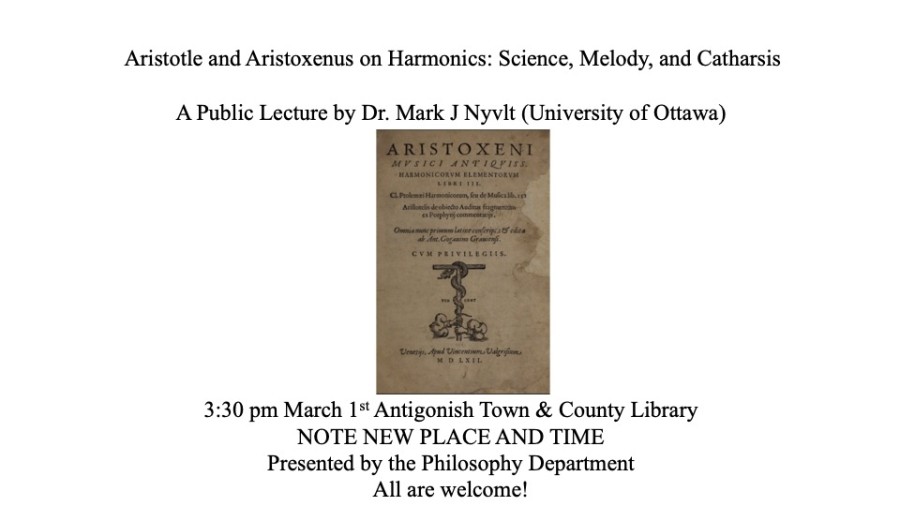
This presentation follows Aristoxenus’ project of establishing Harmonics as an independent science; and to grasp the notion of Melody as it travels through the Great Scalar Systems. This sets up a move from cosmology to psychology where a mapping of the disposition of catharsis emerges, which appeals to the psychagogic disposition of the human soul. In this context, Aristotle’s claim that “science is concerned with a single genus or class of objects which are composed of the primary elements of that genus and are parts of it or essential modifications of those parts” (An. Post. 87a38-40) guides our enquiry. Here, Aristoxenus produces an autonomous science of Music in his Elements of Harmonics. This is accomplished in two tropes: first by developing earlier musical methodologies and approaches, and secondly by applying the Aristotelian apodeixeis or demonstration to justify the rule what Aristotelians called subject limitation. As Aristoxenus says in Book 2, the heart of this science is Melody. Here, the role that Melody plays in Books 2 and 3 in EH resembles noetic Understanding in Aristotle’s An. Post. II.19. Aristoxenus maps the structure of what we perceive when we apprehend Melody (32.10–12) again in the context of a limited science based on apodeixeis (i.e., the demonstrative methodology of Aristotle). Aristoxenus then ups the ante - to propose that Melody in EH is a form of catharsis. Thus, Aristoxenus synthesizes Pythagorean and Platonic notions of Music with the Peripatetic understanding of demonstrative science. Here, the relation between noetic Understanding (An. Post. II.19) and Melody (EH, Book 2) is fundamental to enquiry.