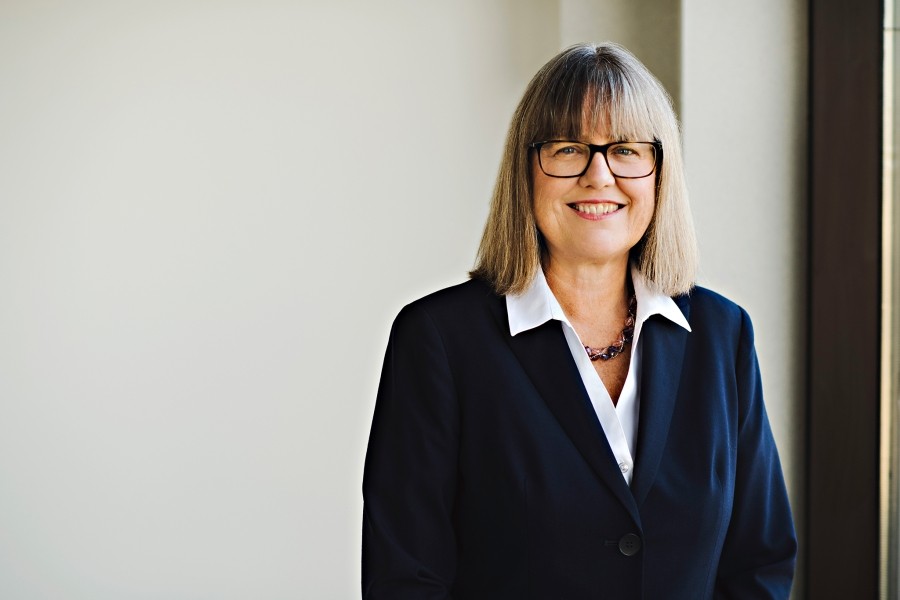
A professor in the Department of Physics and Astronomy at the University of Waterloo, Dr. Strickland shared the 2018 Nobel Prize in Physics for developing chirped pulse amplification, a technique that made the most intense laser pulses ever created possible. Her public lecture will explore how that work opened new ways for light to interact with matter, leading to technologies such as laser eye surgery and the micromachining of glass used in cell phones.
Wednesday November 18
7:00 pm
Schwartz Auditorium (Room 110), Schwartz School of Business
All are welcome to attend.
Abstract: With the invention of lasers, the intensity of a light wave was increased by orders of magnitude over what had been achieved with a light bulb or sunlight. This much higher intensity led to new phenomena being observed, such as violet light coming out when red light went into the material. After Gérard Mourou and I developed chirped pulse amplification, also known as CPA, the intensity again increased by more than a factor of 1,000 and it once again made new types of interactions possible between light and matter. We developed a laser that could deliver short pulses of light that knocked the electrons off their atoms. This new understanding of laser-matter interactions, led to the development of new machining techniques that are used in laser eye surgery or micromachining of glass used in cell phones.
Dr. Donna Strickland: Dr. Strickland is a professor in the Department of Physics and Astronomy at the University of Waterloo and is one of the recipients of the Nobel Prize in Physics 2018 for developing chirped pulse amplification with Gérard Mourou, her PhD supervisor at the time. They published this Nobel-winning research in 1985 when Dr. Strickland was a PhD student at the University of Rochester in New York state. Together they paved the way toward the most intense laser pulses ever created.
Dr. Strickland was a research associate at the National Research Council Canada, a physicist at Lawrence Livermore National Laboratory and a member of technical staff at Princeton University. In 1997, she joined the University of Waterloo, where her ultrafast laser group develops high-intensity laser systems for nonlinear optics investigations.
Dr. Strickland was named a Companion of the Order of Canada. She is a recipient of a Sloan Research Fellowship, a Premier’s Research Excellence Award and a Cottrell Scholar Award. Dr. Strickland served as the president of the Optical Society (OSA) in 2013. She is a fellow of OSA and SPIE, the Royal Society of Canada and the Royal Society. She is an honorary fellow of the Canadian Academy of Engineering as well as the Institute of Physics. She is an international member of the US National Academy of Science. Dr. Strickland earned a PhD in optics from the University of Rochester and a B.Eng. from McMaster University.